Himalayan WhiteHouse International College is an educational institution located in Putalisadak, Kathmandu. Established in 2001, the college offers undergraduate and graduate programs across management, hospitality, engineering, information technology, biotechnology, and liberal arts.
The institution expanded its management education with the establishment of its Graduate School of Management in 2005. Its academic portfolio now brings together programs with distinct modes of study, ranging from laboratory and engineering work to management research, hospitality practice, computing projects, and interdisciplinary liberal arts education.
Programs covered by the college follow curricula of Purbanchal University (PU). Depending on the discipline, these curricula combine lectures, tutorials, practical work, projects, seminars, research, specialization courses, thesis work, and internships.
This variety gives Himalayan WhiteHouse a multidisciplinary academic setting. Civil Engineering and Computer Engineering students study within structured engineering curricula, BIT students combine computing with mathematics, communication, management, and projects, and biotechnology students progress through laboratory-oriented scientific subjects. BHM students work across hospitality operations and management, while BBA, MBA, and EMBA provide different levels of business education. BLAS adds an interdisciplinary route built around liberal arts and social studies.
Established in 2001 and located in Putalisadak, Kathmandu.
Offers undergraduate and graduate programs across management, hospitality, engineering, information technology, biotechnology, and liberal arts.
Programs covered by the college follow Purbanchal University curricula.
Academic programs include BBA, BHM, BLAS, BIT, Bachelor of Civil Engineering, Bachelor of Computer Engineering, B.Tech in Biotechnology, MBA, and Executive MBA.
The Graduate School of Management was established in 2005.
Stated intake capacities include 144 seats each for BBA, BHM, and Civil Engineering; 96 for BIT; 48 each for Computer Engineering and B.Tech in Biotechnology; and 25 for BLAS.
MBA has stated intakes of 33 seats each for Spring and Fall sessions, while EMBA has 30 seats.
Academic delivery varies by program and includes lectures, tutorials, practical work, laboratory study, projects, seminars, research, thesis work, and internships.
The WhiteHouse Placement Cell conducts career guidance, workshops, training, guest lectures, internship-related activities, employer interaction, and alumni activities.
Students across different disciplines follow program-specific practical and academic approaches, from engineering workshops and computing projects to hospitality operations, biotechnology study, management research, and internships.
Himalayan WhiteHouse International College was established with an academic focus on engineering, management, and technology education. Over time, its program portfolio expanded to include hospitality, liberal arts, information technology, biotechnology, and graduate management education.
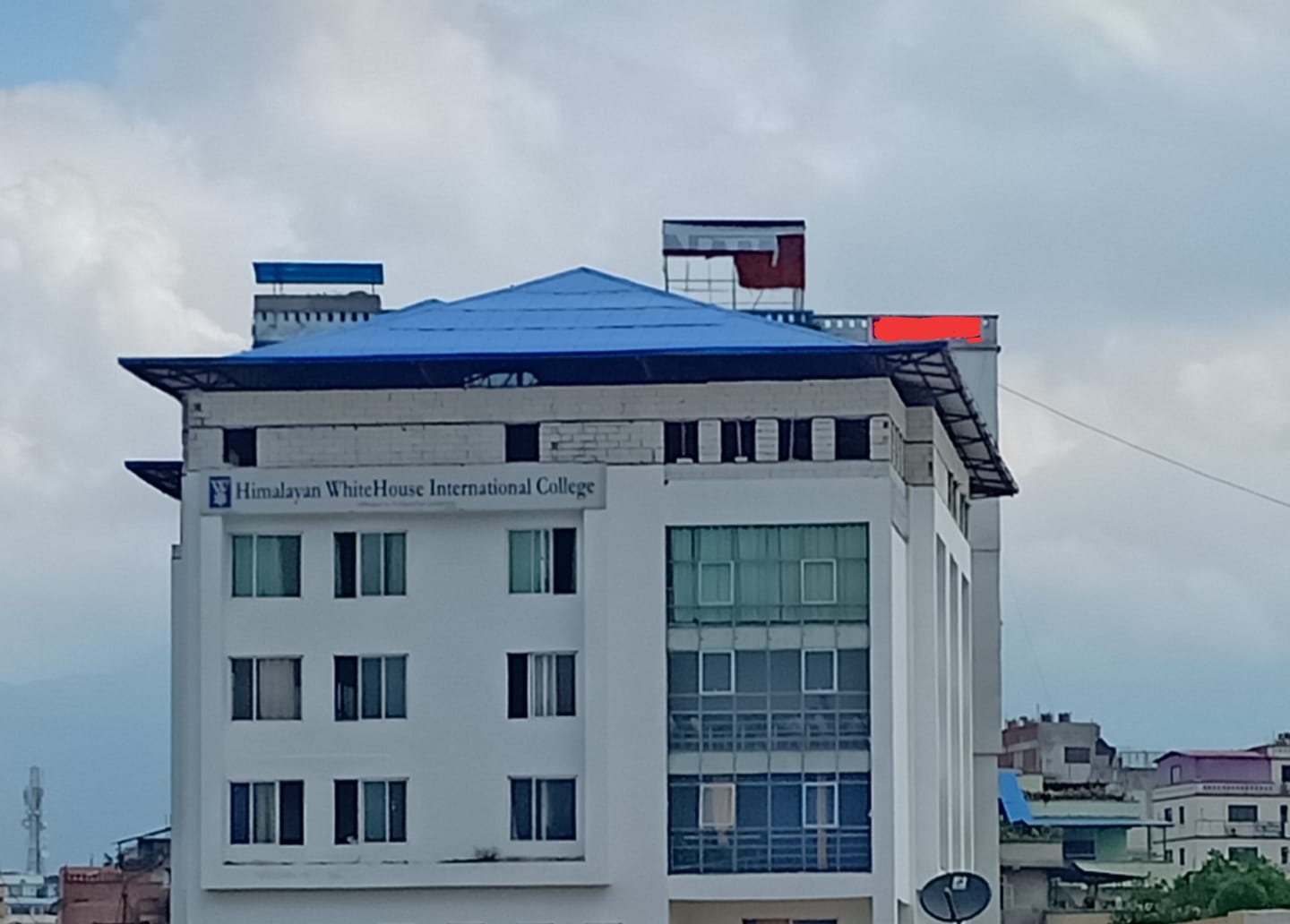
Its stated vision emphasizes professional education, research, training, and the development of graduates with leadership qualities. The mission includes providing educational opportunities to deserving students, delivering curricula that respond to changing needs, encouraging student-centered learning, supporting faculty development, and promoting interaction among students, alumni, academia, and industry.
The institution identifies excellence, creativity, and integrity among its core values. Within its academic context, these ideas are connected with teaching, learning, research, problem-solving, knowledge creation, and responsible professional development.
Student development is not treated only as classroom performance. The college also emphasizes communication, interaction, extracurricular participation, professional exposure, and disciplined academic life. This broader approach appears across its academic programs and student-support activities.
Himalayan WhiteHouse International College offers programs across technology, engineering, management, hospitality, biotechnology, and liberal arts. The stated intake capacities are:
| Program | Seat Capacity | Academic Area |
|---|---|---|
| Bachelor of Information Technology (BIT) | 96 | Information Technology |
| B.Tech in Biotechnology | 48 | Biotechnology |
| Bachelor in Liberal Arts and Sciences (BLAS) | 25 | Liberal Arts and Sciences |
| Bachelor of Civil Engineering (BE Civil) | 144 | Engineering |
| Bachelor of Computer Engineering | 48 | Engineering |
| Bachelor of Business Administration (BBA) | 144 | Management |
| Bachelor of Hotel Management (BHM) | 144 | Hospitality Management |
| Master of Business Administration (MBA) | Spring 33 / Fall 33 | Management |
| Executive Master of Business Administration (EMBA) | 30 | Executive Management |
These programs differ considerably in their academic requirements. Engineering and biotechnology involve substantial technical and practical study, hotel management combines hospitality operations with business subjects and internship work, BIT includes programming and projects, and graduate management programs incorporate seminars, specialization areas, research, and thesis work.
Management is one of the college’s established academic areas. Its management portfolio covers undergraduate business education as well as MBA and Executive MBA study.
The Graduate School of Management, established in 2005, provides the institutional setting for graduate-level management programs. The different programs are designed around separate academic stages rather than a single common structure.
The Bachelor of Business Administration has a stated intake capacity of 144 students.
BBA forms the undergraduate part of the college’s management education. It sits alongside MBA and EMBA within the wider management environment and provides a university-level route for students studying business administration.
BBA students are also part of an institutional setting in which workshops, guest sessions, career guidance, internship information, and other professional-development activities are organized through the WhiteHouse Placement Cell.
The MBA follows a four-semester curriculum totaling 69 credit hours.
The first semester includes Marketing for Managers, Communication for Managers, Accounting for Managers-I, Legal Framework of Business, Decision Sciences, and an elective. These subjects establish a base in communication, marketing, accounting, quantitative decision-making, and the legal context of business.
The second semester includes Accounting for Managers-II, Human Resource Management and Organizational Behavior, Economics for Managers, Financial Management, Operations Management, Seminar I, and an elective.
The third semester moves into Entrepreneurship and Social Enterprises, Research Methodology and Thesis Proposal, Information Technology Management, an elective, Seminar II, and specialization courses.
The final semester covers International Business, Strategic Management, Corporate Governance and Corporate Social Responsibility, Seminar III, additional specialization courses, and a thesis.
The MBA offers specialization areas in Marketing, Finance, Human Resource Management, and Operations and Supply Chain Management. Each area provides a separate group of subjects.
Marketing options include Marketing Research, Product and Brand Management, Sales Management and Retailing, Service Marketing and CRM, and Advertising Management. Finance, human resource management, and operations and supply chain management have corresponding subject groups within their respective areas.
The stated MBA intake is 33 students for the Spring session and 33 for the Fall session.
The Executive MBA has a stated intake capacity of 30 students.
Its curriculum includes Business Management, Microeconomic Analyses, Business Statistics, Management Accounting, Human Resources Management, Managerial Communication, Macroeconomic Analyses, Quantitative Techniques, Organizational Psychology, Marketing Management, Corporate Financial Management, Research Methodology, Strategic Management, Management Information Systems, Productions and Operations Management, International Business, Total Quality Management, specialization subjects, and thesis work.
The program provides specialization choices in Financial Management, Human Resource Management, Marketing Management, and Operations Management.
Financial Management subjects include areas such as financial institutions and markets, international financial management, investment management, portfolio management, capital structure management, and derivative instruments.
Human Resource Management covers areas including human resource planning, organizational change, leadership development, multicultural management, training and development, and negotiation.
Marketing Management includes Consumer Behavior, New Product Development Strategies, Strategic Brand Management, Marketing Research, Service Marketing Strategies, International Marketing Strategies, Promotions Management, and Electronic Marketing Strategies.
Operations Management includes areas such as outsourcing, operations research, productivity management, supply chain and logistics, production planning, maintenance strategies, and project management.
The EMBA admission framework includes a bachelor’s degree requirement and incorporates the Graduate Management Admission Test into the admission process. Prior professional experience also forms part of the program’s admission criteria.
Engineering at Himalayan WhiteHouse includes Bachelor of Civil Engineering and Bachelor of Computer Engineering. Both programs follow semester-based course structures that combine theory with tutorials, practical work, laboratory activity, drawing, workshops, and internal and final assessment.
Although both programs share an engineering foundation, their academic paths become distinct through the subjects associated with their respective disciplines.
The Bachelor of Civil Engineering has a stated intake capacity of 144 students.
The first semester includes Mathematics-I, Chemistry, Applied Mechanics-I (Statics), Civil Engineering Materials, Basic Electrical Engineering, Engineering Drawing-I, and Workshop Technology.
These subjects introduce students to mathematical reasoning, scientific foundations, mechanics, materials, electrical concepts, engineering drawing, and workshop practice at the beginning of the degree.
The second semester continues with Mathematics-II, Physics, Applied Mechanics-II (Dynamics), Building Technology, Fundamental of Thermodynamics and Heat Transfer, and Engineering Drawing-II.
Several early courses contain practical components alongside theory. Chemistry, Civil Engineering Materials, Basic Electrical Engineering, Engineering Drawing, Physics, and technical workshop subjects are structured to include forms of applied study rather than classroom lectures alone.
The curriculum establishes the character of the program from the first year. Mathematics and science are studied alongside mechanics, construction-related subjects, drawing, materials, and workshop activity, giving Civil Engineering a distinct focus within the college’s academic portfolio.
Bachelor of Computer Engineering has a stated intake capacity of 48 students.
Its first semester consists of Mathematics I, Physics, English for Technical Communication, Computer Programming, Fundamental of Computing Technology, Engineering Drawing, and Workshop Technology.
The curriculum introduces programming and computing at the beginning of the degree while retaining mathematics, science, technical communication, drawing, and workshop-based engineering foundations.
The second semester includes Mathematics-II, Chemistry, Object Oriented Programming with C++, Digital Logic, Basic Electrical Engineering, and Applied Mechanics.
Computer Programming includes practical assessment, while Fundamental of Computing Technology also incorporates practical work. Object Oriented Programming with C++ and Digital Logic continue the combination of theoretical and applied technical study.
The early curriculum shows an important distinction between Computer Engineering and BIT. Computer Engineering places computing within a broader engineering framework that includes physics, chemistry, electrical engineering, engineering drawing, mechanics, and workshop practice. BIT approaches computing from an information technology framework that also includes mathematics, communication, management, programming, and projects.
The Bachelor of Information Technology has a stated intake capacity of 96 students.
The first semester carries 19 credits and includes Mathematics-I, Fundamentals of Information Technology, Technical Communication (English), Basic Electrical System & Circuit, Principles of Management, Computer Programming-I, and Project-I.
This combination gives the program a wider first-semester base than programming alone. Students encounter mathematics, computing fundamentals, communication, basic electrical concepts, management, programming, and project activity at the beginning of their studies.
Fundamentals of Information Technology, Basic Electrical System & Circuit, and Computer Programming-I include practical hours. Project-I is also built around practical work.
The first-semester structure therefore introduces project-based and technical activity early in the program rather than separating practical work from foundational study.
BIT admission includes routes for applicants from +2 or equivalent education, Intermediate education, three-year diploma study, and A Level qualifications under the prescribed academic requirements.
The program occupies a distinct place between the college’s engineering and management offerings. Its curriculum connects information technology with quantitative study, technical communication, computing practice, management awareness, and project work.
B.Tech in Biotechnology is a four-year program with a revised 2025 curriculum totaling 155 credits. Its stated seat capacity is 48.
The curriculum begins with core scientific and academic foundations. Semester I includes Physics, Chemistry I, Mathematics, Computer Fundamentals, Communicative English, and Biology.
Semester II introduces Fundamentals of Biotechnology, Chemistry II, Genetics, Cell Biology, and Computer Programming.
The curriculum becomes progressively specialized from the third semester. Semester III includes Microbiology, Biostatistics, Biochemistry, Animal and Plant Physiology, and Chemical Engineering.
Semester IV covers Molecular Biology-I, Immunotechnology, Clinical Biochemistry, Developmental Biology, and Biophysics and Bioinstrumentation.
Semester V continues into Genetic Engineering, Medical Biotechnology, Molecular Biology II, Biochemical Engineering, and Enzyme Technology.
Semester VI includes Bioinformatics, Tissue Culture and Plant Biotechnology, Animal Biotechnology, IPR, Biosafety and Bioethics, Bioprocess Engineering, and Downstream Processing.
Semester VII covers Agricultural Biotechnology, Environmental Biotechnology, Research Methodology, Entrepreneurship Development, and Food and Industrial Biotechnology.
The eighth semester includes elective courses together with Project/Internship and Seminar. Elective subjects include Cancer Biology, Toxicology, and Pharmaceutical Biotechnology.
Across the eight semesters, the curriculum progresses from foundational science into molecular, medical, agricultural, environmental, industrial, and process-oriented biotechnology subjects. Research, entrepreneurship, project work, and internship activity appear in the later stages of the degree.
Bachelor of Hotel Management is a four-year program with a stated intake capacity of 144 students.
The curriculum is organized across eight semesters and combines hospitality operations with management, accounting, tourism, research, law, human resources, marketing, and internship work.
The first semester covers Front Office Operation-I, Food and Beverage Service-I, Housekeeping-I, Food Production-I, English for Hospitality, and Principle of Management.
The second semester continues the main operational areas through Front Office Operation-II, Food and Beverage Service-II, Housekeeping-II, and Food Production-II. Personality Development and Fundamental of Travel and Tourism are also included.
Semester III introduces Economics of Tourism and Hospitality, Food and Beverage Service-III, Principles of Accounting, Food Production, Hotel French, and Food Science and Nutrition.
Semester IV includes Organizational Behavior, Bartending and Beverage Management, Food Production-IV, Customer Safety and Security, Hotel Accounting, and Statistics.
By Semester V, students study Hotel Maintenance and Engineering, Hospitality Law, Bakery and Confectionary, Entrepreneurship Development, Hospitality Management Information, and Human Resource Development.
Semester VI includes Research Methodology, Food and Beverage Management, Food Production Operation, Hospitality Marketing, Strategic Management, and Professional Seminar.
The later part of the program places substantial emphasis on Internship and Report Writing.
BHM therefore combines the operational side of hospitality with broader areas of business and management. Students encounter front office operations, food production, housekeeping, beverage service, tourism, accounting, safety, law, marketing, human resources, research, and internship work within one program.
The Bachelor in Liberal Arts and Sciences has been offered at Himalayan WhiteHouse under Purbanchal University since 2005. Its stated intake capacity is 25 students.
BLAS represents a different academic direction from the college’s engineering, technology, management, and hospitality programs.
Its areas of study include development and media studies, with attention to International Relations, Gender Studies, Media Analysis, Literature, Culture, and Resource Management.
The program is interdisciplinary in character. Rather than concentrating on a single technical profession, it brings together subjects concerned with society, communication, culture, development, media, and related fields of study.
Within Himalayan WhiteHouse, BLAS gives liberal arts and social studies a place alongside professional, scientific, and technical programs.
Practical study appears differently across the college’s academic programs.
Engineering curricula combine lectures with tutorials, laboratory or practical components, drawing, and workshop work. Computer Engineering introduces programming and computing practice alongside conventional engineering foundations.
BIT includes programming and project activity from its first semester. Biotechnology progresses through scientific subjects before moving into advanced biotechnology areas, research, seminar work, and project or internship activity.
BHM uses a different form of practical study through front office operations, food production, food and beverage service, housekeeping, bartending, bakery and confectionary, and later internship work.
Graduate management programs emphasize another form of applied learning through seminars, specialization courses, research methodology, thesis preparation, and thesis work.
These differences allow each academic area to maintain the type of practical activity suited to its curriculum rather than applying one common approach across every program.
The WhiteHouse Placement Cell operates under the Management Development Cell and works on career-oriented activities for students. Graduate and undergraduate students participate in the Cell under the guidance of a faculty member.
Its activities include workshops, seminars, training programs, guest lectures, talk series, career guidance, alumni interaction, internship coordination, and job-related events.
Career-preparation activities include mock interviews, group discussions, soft-skills training, CV writing, research writing, Advanced Excel training, and digital marketing workshops.
The Cell also organizes guest lectures and talk sessions on management and market-related subjects, creating opportunities for students to interact with visiting faculty members and resource persons outside their regular classes.
Internship and job-related activities form another part of its work. Campus placement events are organized with banks and financial institutions and corporate organizations. Internship opportunities are also connected with the college’s College-Corporate Connect Program.
Information about vacancies, internships, and related opportunities is circulated through the Cell’s communication channels.
Alumni interaction is supported through alumni meetings intended to maintain connections between former students and the institution. Together, these activities give the Placement Cell a supporting role around career preparation, professional communication, internship information, employer interaction, and skill development.
Himalayan WhiteHouse places academic learning alongside communication, organization, creativity, leadership, and interaction beyond regular classroom teaching.
This approach is visible in both formal curricula and co-curricular activity. Degree programs require different combinations of projects, laboratory work, practical classes, technical exercises, seminars, research, thesis work, or internships. Outside the prescribed curriculum, workshops, discussions, guest sessions, career guidance, alumni activities, and professional training provide additional forms of student participation.
The nature of student engagement depends on the program. A Civil Engineering student may spend time on technical drawing, mechanics, workshops, and engineering practical work. A Computer Engineering or BIT student may work with programming and computing projects. A biotechnology student follows science and laboratory-oriented study. A BHM student encounters hospitality operations and internship work, while MBA and EMBA students move through seminars, specialization subjects, research, and thesis activities.
This multidisciplinary structure allows students from different fields to study within the same institution while following academic methods appropriate to their own disciplines.
Himalayan WhiteHouse International College is located in Putalisadak, Kathmandu.
Address: Putalisadak, Kathmandu
Phone: 01-4222688, 4226284, 9843207064
Email: Info@whitehousegsm.edu.np
Website: www.whitehousecmt.edu.np
Himalayan WhiteHouse International College has operated in Putalisadak, Kathmandu since 2001 and offers undergraduate and graduate programs across management, hospitality, engineering, information technology, biotechnology, and liberal arts.
Its academic portfolio includes BBA, BHM, BLAS, BIT, Bachelor of Civil Engineering, Bachelor of Computer Engineering, B.Tech in Biotechnology, MBA, and Executive MBA. The programs follow distinct academic structures, ranging from engineering laboratories and technical workshops to hospitality practice, computing projects, biotechnology study, management specialization, research, thesis work, and internships.
The college’s wider student environment also includes the WhiteHouse Placement Cell, which organizes career guidance, workshops, guest lectures, professional-development sessions, internship information, employer interaction, and alumni activities.
Taken together, its multidisciplinary programs, Purbanchal University curricula, practical components, research activities, and student-development initiatives form the academic structure of Himalayan WhiteHouse International College.
Himalayan WhiteHouse International College (HWHIC) is located in Putalisadak, Kathmandu.
Himalayan WhiteHouse International College was established in 2001.
The programs covered by the college follow curricula of Purbanchal University (PU).
The college offers BBA, BHM, BLAS, BIT, Bachelor of Civil Engineering, Bachelor of Computer Engineering, B.Tech in Biotechnology, MBA, and Executive MBA.
The stated intake capacity for the Bachelor of Information Technology (BIT) program is 96 students.
The stated intake capacity is 144 students for Bachelor of Civil Engineering and 48 students for Bachelor of Computer Engineering.
The stated intake capacity is 144 students each for the Bachelor of Business Administration (BBA) and Bachelor of Hotel Management (BHM).
The stated intake capacity is 48 students for B.Tech in Biotechnology and 25 students for Bachelor in Liberal Arts and Sciences (BLAS).
The MBA has stated intakes of 33 students for the Spring session and 33 students for the Fall session. The Executive MBA has a stated intake capacity of 30 students.
Yes. Depending on the program, academic study includes practical work, laboratory activities, workshops, projects, seminars, research, thesis work, or internships.
Yes. The WhiteHouse Placement Cell organizes career guidance, workshops, training programs, guest lectures, internship-related activities, employer interaction, and alumni activities.
The college offers programs across management, hospitality, engineering, information technology, biotechnology, and liberal arts.