Nepal Engineering College (nec) was established in 1994 as a not-for-profit social academic institute in Nepal. Founded by Nepalese professionals, academicians, managers, and industrialists, the college was created to expand opportunities for higher technical education in engineering, technology, and related disciplines. It is registered with the District Administration Office in Bhaktapur and offers undergraduate and postgraduate programs affiliated with Pokhara University.
The main campus is located in Changunarayan Municipality-4, Bhaktapur. It occupies 210 ropanies, equivalent to 10.69 hectares, beside the Manohara River. Regular bachelor's programs in engineering and architecture are conducted at Changunarayan, while postgraduate education is organized through the nec Center for Postgraduate Studies at Prayag Pokhari, Lagankhel, Lalitpur.
A separate academic arrangement is used for the Bachelor in Civil Engineering for Diploma Holders program. This program is conducted through nec-BDH in Lalitpur and operates as an evening program, with classes arranged for diploma graduates.
nec's academic portfolio covers civil engineering, civil and rural engineering, computer engineering, information technology, electrical and electronics engineering, communication-related engineering, architecture, construction management, transportation engineering and management, natural resources management, and interdisciplinary water resources management.
Its instructional resources include engineering laboratories, an Architecture Design Studio, a library with more than 40,000 books, journals, and magazines, and field visits or educational tours within BE and B.Arch. programs. These resources support classroom study, practical work, design activity, field learning, projects, and research according to individual program requirements.
| Particular | Details |
|---|---|
| Institution | Nepal Engineering College (nec) |
| Established | 1994 |
| Institutional character | Not-for-profit social academic institute |
| Registration | District Administration Office, Bhaktapur |
| Main campus | Changunarayan Municipality-4, Bhaktapur |
| Campus area | 210 ropanies / 10.69 hectares |
| University affiliation | Pokhara University |
| Academic levels | Bachelor's and Master's |
| Postgraduate center | nec Center for Postgraduate Studies, Prayag Pokhari, Lagankhel, Lalitpur |
| Civil diploma-holder program | nec-BDH, Lalitpur |
| Civil for Diploma Holders intake | 48 seats |
| Civil for Diploma Holders schedule | Evening program |
Nepal Engineering College began in 1994 when private-sector engineering education in Nepal was still limited. Its founders identified a need for an institution serving students seeking higher education in engineering, technology, and related fields.
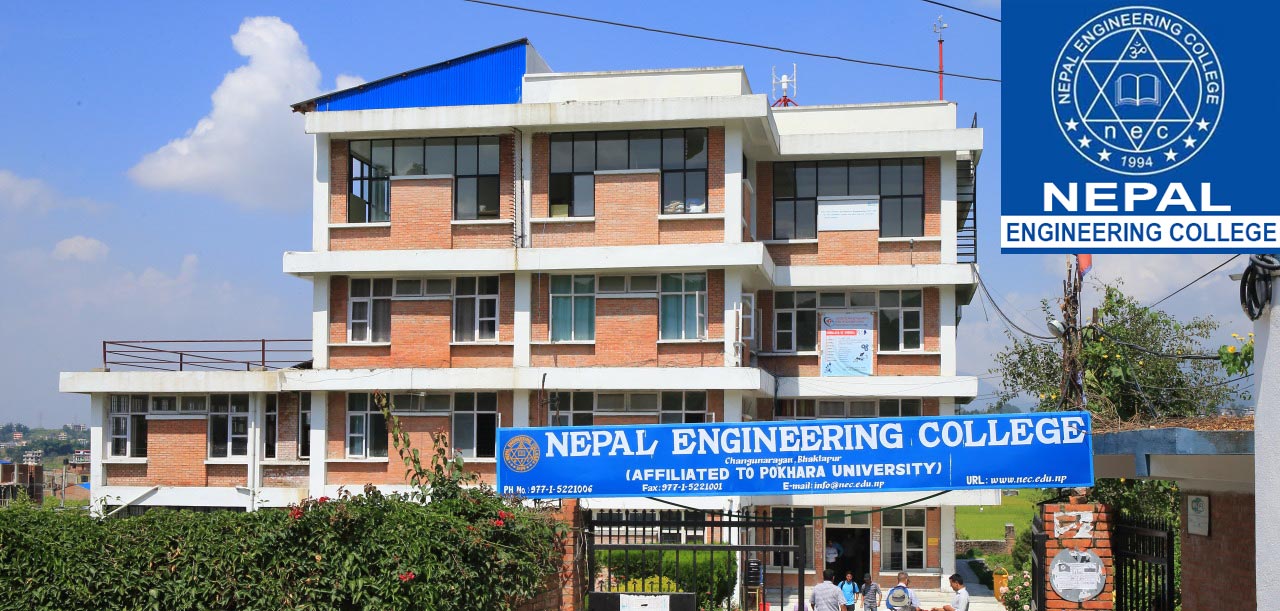
The college began with comparatively limited physical and instructional resources. Its subsequent development included expansion of academic programs, laboratories, teaching resources, faculty strength, library holdings, and campus infrastructure.
Civil Engineering has been offered since the establishment of nec in 1994. Computer Engineering was introduced in the academic year 1999. Civil and Rural Engineering followed in 2008, extending the college's academic work into an engineering program with an explicit rural-development orientation.
The expansion of the program portfolio also created a broader disciplinary mix. Alongside infrastructure-related study, nec developed programs in computing, electrical and electronics engineering, communication engineering, architecture, information technology, and specialized postgraduate fields.
The development of postgraduate education resulted in a separate academic base in Lalitpur. Master's programs are conducted through the nec Center for Postgraduate Studies rather than through the main undergraduate campus at Changunarayan.
The Bachelor in Civil Engineering for Diploma Holders also follows a separate teaching arrangement in Lalitpur. It has an intake of 48 seats and is identified as an evening program. The college's detailed program information also refers to evening and weekend class arrangements for this diploma-holder pathway.
The vision of nec connects higher learning with three institutional functions: education, research, and outreach. These areas form the stated direction of the college's academic work.
Its mission focuses on the academic, technical, professional, personal, and social development of students. Its stated priorities include:
providing young people with opportunities and a learning environment intended to support academic standards, scientific temper, technical competence, professional competence, and life skills;
developing students who are prepared to serve society and contribute to improvements in people's quality of life; and
encouraging ethical standards in personal, social, and public life, together with responsibility toward society and the nation.
This institutional direction is reflected in the range of academic subjects offered at nec. Its programs include conventional engineering disciplines alongside study connected with rural development, construction, transportation, natural resources, and water resources.
The main campus of Nepal Engineering College is situated in Changunarayan Municipality-4, Bhaktapur. The site covers 210 ropanies, or 10.69 hectares, beside the Manohara River.
Regular bachelor's programs in engineering and architecture are conducted at the Changunarayan campus. Postgraduate programs operate through the nec Center for Postgraduate Studies at Prayag Pokhari, Lagankhel, Lalitpur.
The Bachelor in Civil Engineering for Diploma Holders is organized separately through nec-BDH in Lalitpur.
| Academic location | Main academic use |
|---|---|
| Changunarayan, Bhaktapur | Regular bachelor's engineering and B.Arch. programs |
| Prayag Pokhari, Lagankhel, Lalitpur | Master's programs through nec-CPS |
| nec-BDH, Lalitpur | Civil Engineering for Diploma Holders |
The distinction between these locations matters for applicants because the institution has more than one teaching site. Program name and academic location should therefore be considered together when reviewing a course at nec.
Nepal Engineering College offers its degree programs under Pokhara University.
The university affiliation covers the bachelor's and master's programs within the college's academic portfolio. Program structures, semester arrangements, research components, and academic requirements vary according to the degree.
The Bachelor of Civil Engineering structure provides one example of the university's engineering curriculum. The 2025 structure extends across eight semesters and carries 129 credits. It begins with mathematics, science, programming, engineering drawing, mechanics, electrical and electronics fundamentals, engineering geology, civil engineering materials, and workshop study before moving into specialized civil engineering subjects.
Advanced semesters include surveying, fluid mechanics, hydraulics, structural analysis, soil mechanics, foundation engineering, transportation engineering, environmental engineering, irrigation and drainage, construction project management, hydropower engineering, project work, professional practice, electives, and internship.
Postgraduate programs follow their own academic structures. Construction Management and Transportation Engineering and Management, for example, combine coursework with substantial research or thesis requirements.
Nepal Engineering College offers bachelor's and master's programs under Pokhara University.
Its undergraduate portfolio covers engineering, computing, architecture, and a civil engineering pathway for diploma holders. At postgraduate level, the academic focus includes construction, transportation, natural resources, and water resources.
The bachelor's intake includes the following seat distribution:
The intake listing specifically identifies Architecture with 48 seats, Civil with 144, Civil & Rural with 48, Computer with 96, Electrical & Electronics with 48, Information & Communication with 96, and Civil for Diploma Holders with 48 seats. The Civil for Diploma Holders entry is marked as an evening program.
| SN | Program | Standard Fee/ Existing Fee (NRs) |
|---|---|---|
| 1 | B. Architecture (5 Year Course), 48 Seats | 1,144,500.00 |
| 2 | BE Civil (4 Year Course), 144 Seats | 941,500.00 |
| 3 | BE Computer (4 Year Course), 96 Seats | 941,500.00 |
| 4 | BE Civil & Rural (4 Year Course), 48 Seats | 941,500.00 |
| 5 | BE Electrical & Electronics (4 Year Course), 48 Seats | 941,500.00 |
| 6 | BE Electronics & Communication (4 Year Course), 96 Seats | 941,500.00 |
| 7 | BE Civil for Diploma Holders (4.5 Year Course), 48 Seats Evening program | 1,038,225.00 |
| 8 |
BE in Information Technology (BE.IT) (4 Year Course), 48 Seats |
941,500.00 |
The individual degree titles remain important when comparing academic options. Civil Engineering, Civil and Rural Engineering, and Civil Engineering for Diploma Holders are separate pathways. Computer Engineering and Engineering in Information Technology are also distinct programs.
The four listed master's programs each have an intake of 30 seats.
| Program | Level | Seats |
|---|---|---|
| M.Sc in Transportation Engineering and Management | Master's | 30 |
| M.Sc in Natural Resources Management | Master's | 30 |
| M.Sc in Construction Management | Master's | 30 |
| M.Sc in Interdisciplinary Water Resources Management | Master's | 30 |
These postgraduate programs are organized through the nec Center for Postgraduate Studies in Lalitpur.
Civil Engineering has been part of Nepal Engineering College since 1994. The bachelor's intake for Civil is 144 seats.
The program addresses the design, construction, operation, and maintenance of physical infrastructure and related services.
Its academic areas include:
material engineering;
structural engineering;
environmental engineering;
transportation engineering;
water resources engineering;
geotechnical engineering; and
surveying.
The 2025 Pokhara University Bachelor of Civil Engineering structure shows how these areas develop across eight semesters.
First-year study begins with Applied Chemistry, Applied Physics, Calculus I, Computer Programming, Engineering Drawing, Applied Mechanics, Algebra and Geometry, Basic Electrical and Electronics Engineering, Civil Engineering Materials, Civil Engineering Workshop, Engineering Geology, and Introduction to Energy Engineering.
The second year moves further into civil engineering through Building Technology, Calculus II, Fluid Mechanics, Numerical Methods, Strength of Materials, Surveying I, Project I, Hydraulics, Probability and Statistics, Communication Techniques, Soil Mechanics, Structural Analysis I, and Surveying II.
Third-year study includes Engineering Hydrology, a Survey Field Project, Foundation Engineering, Structural Analysis II, Transportation Engineering I, Water Supply Engineering, Concrete Technology and Masonry Structure, Engineering Economics, Design of Steel and Timber Structure, Irrigation and Drainage Engineering, Sanitary Engineering, Transportation Engineering II, and elective study.
The final year includes Project II, Construction Project Management, Design of R.C.C. Structures, Estimating and Valuation, Hydropower Engineering, additional elective study, Engineering Professional Practice, and an internship.
The complete structure carries 129 credits.
The curriculum combines theoretical study with surveying, practical components, design work, projects, professional study, and internship. Students therefore move from general engineering foundations into specialized infrastructure subjects as they progress through the program.
nec introduced Civil and Rural Engineering in 2008. The intake is 48 seats.
The program was developed around the relationship between engineering, rural infrastructure, agriculture, natural resources, services, and rural development.
Its academic rationale recognizes that rural development involves several connected technical requirements. Infrastructure, resource management, agricultural activities, engineering services, and local development conditions can affect one another within rural settings.
Civil and Rural Engineering therefore gives civil engineering study a specific rural-development orientation.
Areas associated with the program include:
rural infrastructure development;
natural resources management;
agro-industries;
development agencies;
rural credit institutions; and
conventional civil engineering projects.
The program sits alongside the regular Bachelor of Civil Engineering but retains its own academic identity.
Computer Engineering was introduced at Nepal Engineering College in the academic year 1999. The bachelor's intake is 96 seats.
Its academic concept brings together computer science and microelectronics. The program includes programming knowledge, microelectronics, and software-hardware interfacing skills.
This gives Computer Engineering a technical base extending across both computing concepts and hardware-related engineering.
Within the wider nec portfolio, Computer Engineering sits alongside Engineering in Information Technology, Electrical and Electronics Engineering, and communication-related engineering programs.
Students comparing these courses should treat each as an individual degree rather than assuming that overlapping subjects make the programs equivalent.
The Bachelor of Engineering in Information Technology provides another computing-related path within the nec academic portfolio.
It is offered separately from Computer Engineering. The distinction should be maintained when comparing the two because each has its own program identity within the Pokhara University academic framework.
The program contributes to the computing and information-technology side of nec's undergraduate study alongside Computer Engineering and other electronics- and communication-oriented courses.
The Bachelor of Electrical and Electronics Engineering has an intake of 48 seats.
The program combines areas associated with electrical engineering and electronics within one degree. Electrical engineering addresses large-scale electrical systems such as generation, transmission, and utilization of electricity, while electronics covers another technical area within the combined program.
nec identifies both Electrical and Electronic laboratories among its instructional facilities.
Electrical and Electronics Engineering remains a separate degree from communication-oriented engineering programs within the college.
The college's undergraduate academic portfolio includes Bachelor of Electronics and Communication Engineering, while the current seat distribution identifies a 96-seat entry under Information & Communication.
The seat terminology is retained as a separate intake label rather than being treated as interchangeable with another program title. This preserves the distinction between the formal program names used across the academic portfolio and the wording of the seat distribution.
Communication-related engineering study forms part of the broader electrical, electronics, computing, and information-technology group of disciplines at nec.
The Bachelor of Architecture has an intake of 48 seats.
Architecture is offered as a separate academic stream within Nepal Engineering College. Students have access to an Architecture Design Studio among the college's instructional resources.
The college also includes field visits or educational tours in BE and B.Arch. programs. These activities add an off-campus component to disciplines in which observation of buildings, sites, structures, environments, and professional work can form part of academic study.
Architecture retains its own B.Arch. degree identity rather than being treated as an engineering specialization.
The Bachelor in Civil Engineering for Diploma Holders has an intake of 48 seats and is an evening program.
Unlike the regular bachelor's programs conducted at Changunarayan, this program is organized separately through nec-BDH in Lalitpur.
The diploma-holder pathway is intended for students entering civil engineering study after completing diploma-level engineering education. Its academic arrangement builds on prior diploma study and includes civil engineering subjects across basic sciences, materials, structures, water resources, geotechnical engineering, and transportation.
The college's detailed program description refers to evening classes on working days and weekend classes, an arrangement connected with the profile of students who may already be employed.
nec therefore has three distinct civil-oriented bachelor's pathways:
Bachelor of Civil Engineering — 144 seats;
Bachelor of Civil and Rural Engineering — 48 seats; and
Bachelor in Civil Engineering for Diploma Holders — 48 seats, evening program.
These are separate academic routes and should not be treated as different labels for the same degree.
The nec Center for Postgraduate Studies at Prayag Pokhari, Lagankhel, Lalitpur is the academic location for the college's master's programs.
Its postgraduate portfolio is concentrated in subjects connected with infrastructure, planning, construction, transportation, natural resources, and water resources.
The four listed programs are:
M.Sc in Construction Management — 30 seats;
M.Sc in Transportation Engineering and Management — 30 seats;
M.Sc in Natural Resources Management — 30 seats; and
M.Sc in Interdisciplinary Water Resources Management — 30 seats.
The postgraduate center provides a separate setting for advanced coursework and research beyond the undergraduate engineering and architecture programs conducted through nec.
The Master of Science in Construction Management is structured as a two-year program spread across four semesters.
Students complete 45 credit hours of coursework and 15 credit hours of research project work.
The curriculum contains five broad components:
foundation and analytical courses;
core and functional courses;
capstone courses;
elective courses; and
thesis research.
Students are required to take two elective courses of three credit hours each. The thesis carries 15 credits and requires research involving fieldwork and empirical analysis.
The normal duration is 24 months, or four semesters. Each semester is arranged for 15 weeks excluding examinations.
Academic work can include classroom discussion, presentations, group work, case analysis, guest lectures, and research project activity.
Eligibility covers graduates from relevant engineering fields who have at least 15 years of formal education and a minimum CGPA of 2.0 or 45 percent at bachelor's level.
The relevant fields identified for the program include:
Civil Engineering;
Electrical Engineering;
Mechanical Engineering;
Geotechnical Engineering;
Hydropower Engineering; and
Architecture.
Admission includes an entrance test. The selection structure also considers bachelor's-level performance and experience alongside entrance-test performance.
The M.Sc in Transportation Engineering and Management is organized across two years and four semesters.
Students complete 45 credit hours of coursework together with 15 credit hours of research work.
The curriculum includes:
Transportation Policy;
Transportation Networking;
Principles of Transportation Engineering;
Traffic Engineering;
Transport Planning Methods;
Transportation Economics;
Transport Planning Studio;
Research Methods;
Transport Safety;
Organization Behavior and Human Resource Management;
elective courses; and
thesis.
The fourth-semester thesis carries 15 credit hours.
The program is intended particularly for Civil Engineering graduates. Eligibility requires a second division or 2.0 GPA in Civil Engineering from an institution recognized by Pokhara University. Nepalese applicants are required to take an entrance test conducted by the college.
Its academic structure combines technical transportation subjects with planning, economics, management, organizational study, policy, safety, and research.
The postgraduate portfolio also includes M.Sc in Natural Resources Management and M.Sc in Interdisciplinary Water Resources Management.
Each program has 30 seats and is conducted through the nec Center for Postgraduate Studies in Lalitpur.
Their inclusion alongside Construction Management and Transportation Engineering and Management gives the postgraduate center an academic concentration across infrastructure, resources, planning, management, and water-related study.
Nepal Engineering College identifies a range of discipline-specific practical and instructional facilities.
| Resource | Related academic area |
|---|---|
| Computer laboratory | Computing |
| Electronic laboratory | Electronics |
| Electrical laboratory | Electrical engineering |
| Civil laboratory | Civil engineering |
| Civil & Rural laboratory | Civil and rural engineering |
| Architecture Design Studio | Architecture |
| Library | Books, journals, magazines, and study materials |
The laboratory structure corresponds with the principal academic disciplines taught at the main campus.
Civil Engineering has civil engineering laboratory resources, while Civil and Rural Engineering has a dedicated Civil & Rural laboratory. Electrical and electronics disciplines are supported through Electrical and Electronic laboratories. Computing-related study has a Computer laboratory, and Architecture has a Design Studio.
These facilities operate alongside classroom teaching and the practical requirements built into individual curricula.
The college library contains more than 40,000 books, journals, and magazines.
The collection supports academic study across the different programs offered by nec and forms part of the instructional infrastructure at the main campus.
For an institution covering civil engineering, computing, electronics, electrical engineering, architecture, transportation, construction management, and resource-related study, the library provides a shared academic resource across disciplines.
Nepal Engineering College records around 125 qualified full-time faculty members and around 100 non-academic staff.
Its academic arrangements also include part-time faculty with industrial experience and visiting faculty from foreign universities.
The staffing structure supports teaching across engineering, architecture, computing, management-related postgraduate programs, and research-based study.
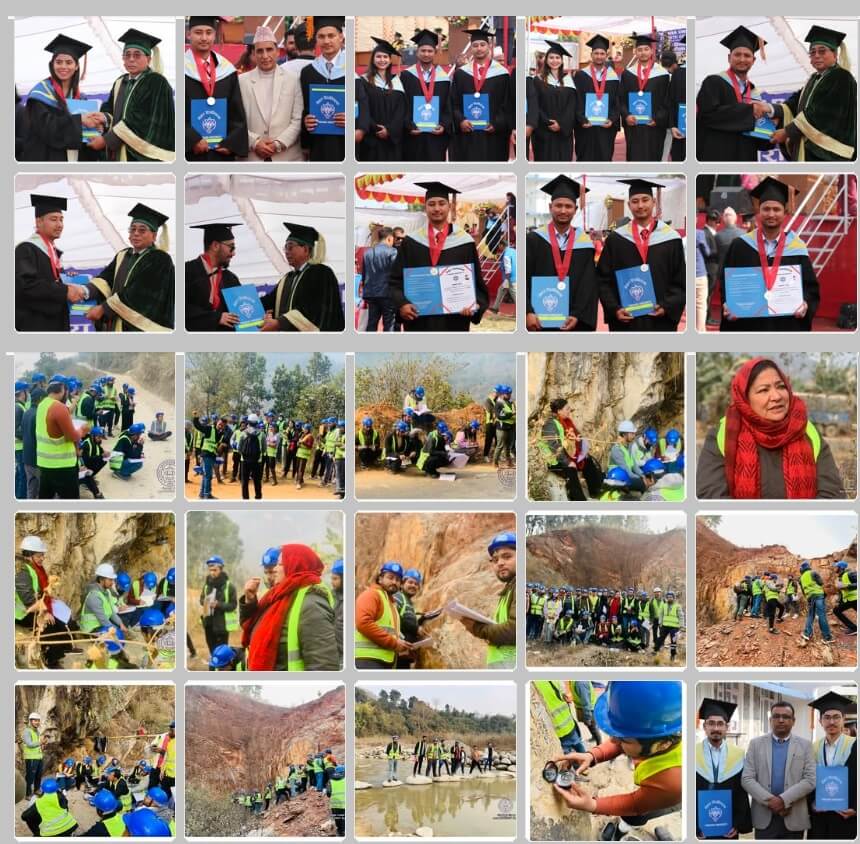
Depending on the program, academic work may include classroom lectures, laboratory exercises, surveying, studio work, field visits, projects, presentations, internship, research, and thesis work.
nec includes two to three field visits or educational tours for every BE and B.Arch. program.
Field-based study has particular relevance to courses connected with physical infrastructure, buildings, surveying, transportation, construction, rural systems, and engineering sites.
The Bachelor of Civil Engineering curriculum provides a clear example. It includes Surveying I and II, a Survey Field Project, Project I, Project II, laboratory-related subjects, design courses, and an internship.
Architecture has a studio-based component through the Architecture Design Studio, while field visits and educational tours add another form of learning outside regular classroom instruction.
Nepal Engineering College identifies institutional linkages with several universities and organizations.
They include:
Ball State University, USA;
Ehime University, Japan;
Indian Society for Technical Education (ISTE);
Imperial College London;
South Asian Consortium for Interdisciplinary Water Resources Studies (SaciWATERs), Hyderabad, India; and
MVA Asia Ltd., Hong Kong.
These are institutional linkages and should not be interpreted as guarantees of student exchange, admission advantages, employment, placement, or other individual outcomes.
For Pokhara University science and technology engineering programs, applicants are required to have completed Grade 12 in the Science stream or an equivalent qualification from a recognized institution.
The academic criteria include study in Physics, Chemistry, and Mathematics.
The stated minimum requirements include:
at least a C grade or 45 percent in each of Physics, Chemistry, and Mathematics;
an overall GPA of 2.0 or equivalent; and
Mathematics of at least 100 marks in Grade 11 or Grade 12.
The Pokhara University undergraduate admission framework also includes an entrance examination, with admission based on merit linked to entrance-examination performance.
The Civil Engineering for Diploma Holders program follows a different academic route because it is intended for diploma graduates. Its intake is 48 seats and it operates as an evening program.
Entry requirements vary according to the master's program.
For M.Sc in Construction Management, graduates from relevant engineering fields identified in the curriculum are eligible subject to the stated academic requirements. The program requires at least 15 years of formal education and a minimum CGPA of 2.0 or 45 percent at bachelor's level.
Its admission process includes an entrance test, while the selection structure also considers bachelor's-level performance and experience.
For M.Sc in Transportation Engineering and Management, applicants are required to have a second division or 2.0 GPA in Civil Engineering from an institution recognized by Pokhara University. Nepalese applicants must take an entrance test conducted by the college.
These differences make program-specific eligibility important when considering postgraduate study at nec.
The academic structure of Nepal Engineering College is built around engineering, architecture, computing, infrastructure, management, transportation, and resource-related study.
Civil Engineering remains the institution's longest-running program, dating from 1994, and currently has the largest stated bachelor's intake at 144 seats. Computer Engineering has 96 seats, while Civil and Rural Engineering and Electrical and Electronics Engineering each have 48 seats.
Architecture has 48 seats. The listed Information & Communication intake is 96 seats, while Civil for Diploma Holders has 48 seats and operates as an evening program.
Computer Engineering was introduced in 1999, while Civil and Rural Engineering followed in 2008. These programs expanded the undergraduate academic portfolio beyond the original civil engineering base.
At postgraduate level, Construction Management, Transportation Engineering and Management, Natural Resources Management, and Interdisciplinary Water Resources Management each have an intake of 30 seats.
The institution's academic organization is also defined by location. Regular bachelor's engineering and architecture programs are based at Changunarayan in Bhaktapur. Master's programs are conducted through nec-CPS in Lalitpur. The Civil Engineering for Diploma Holders pathway follows its separate nec-BDH arrangement in Lalitpur.
The college's facilities correspond with its disciplinary range. Civil, Civil & Rural, Electrical, Electronic, and Computer laboratories support different engineering fields, while Architecture has a Design Studio. The library provides a shared academic resource with more than 40,000 books, journals, and magazines.
Field visits and educational tours form part of BE and B.Arch. study, while individual curricula may include surveying, laboratory work, projects, internship, research, studio activity, or thesis work.
For students comparing programs at Nepal Engineering College, the key distinctions include degree title, academic field, seat intake, study location, entry pathway, and course structure. These differences are particularly important across the civil engineering routes and between regular bachelor's study, the evening diploma-holder program, and postgraduate education.
Nepal Engineering College (nec) was established in 1994 as a not-for-profit social academic institute.
The main campus of Nepal Engineering College is located in Changunarayan Municipality-4, Bhaktapur. It covers 210 ropanies, or 10.69 hectares, beside the Manohara River.
Nepal Engineering College is affiliated with Pokhara University for its listed bachelor's and master's degree programs.
Regular bachelor's engineering and B.Arch. programs are conducted at the main campus in Changunarayan, Bhaktapur. The Bachelor in Civil Engineering for Diploma Holders follows a separate academic arrangement through nec-BDH in Lalitpur.
The master's programs are conducted through the nec Center for Postgraduate Studies at Prayag Pokhari, Lagankhel, Lalitpur.
The bachelor's portfolio includes Civil Engineering, Civil and Rural Engineering, Computer Engineering, Electrical and Electronics Engineering, Electronics and Communication Engineering, Engineering in Information Technology, Architecture, and Civil Engineering for Diploma Holders.
The Bachelor of Civil Engineering intake is 144 seats.
The stated undergraduate intake includes 48 seats in Architecture, 144 in Civil, 48 in Civil & Rural, 96 in Computer, 48 in Electrical & Electronics, 96 under Information & Communication, and 48 in Civil for Diploma Holders.
Yes. The Civil Engineering for Diploma Holders program has 48 seats and is identified as an evening program.
nec offers M.Sc in Transportation Engineering and Management, M.Sc in Natural Resources Management, M.Sc in Construction Management, and M.Sc in Interdisciplinary Water Resources Management.
Each of the four listed master's programs has an intake of 30 seats.
The college has Computer, Electronic, Electrical, Civil, and Civil & Rural laboratories, an Architecture Design Studio, and a library containing more than 40,000 books, journals, and magazines.
Yes. BE and B.Arch. programs include two to three field visits or educational tours.
Computer Engineering was introduced in the academic year 1999, while Civil and Rural Engineering was introduced in 2008.
The college's academic portfolio covers engineering, architecture, computing, infrastructure, transportation, construction management, natural resources, and water resources at bachelor's and master's levels.