



The M.Sc in Transportation Engineering and Management at Nepal Engineering College (nec) is a postgraduate engineering program affiliated with Pokhara University. The program is conducted through the nec Center for Postgraduate Studies (nec-CPS) at Prayag Pokhari, Lagankhel, Lalitpur.
Also known as M.Sc. TEAM, the program is intended specifically for Civil Engineering graduates who want advanced study in transportation planning, traffic engineering, transport policy, transport economics, transportation networks, safety, project management, and transport infrastructure. The course has been underway at nec since 2010.
The program takes two years and is organized into four semesters. Students complete 45 credit hours of coursework and a 15-credit thesis, making 60 credits in total. The stated intake at Nepal Engineering College is 30 seats.
| Particular | Details |
|---|---|
| Course | M.Sc in Transportation Engineering and Management |
| Short form | M.Sc. TEAM |
| Institution | Nepal Engineering College (nec) |
| Affiliation | Pokhara University |
| Academic level | Master's |
| Duration | 2 years |
| Academic structure | 4 semesters |
| Coursework | 45 credits |
| Thesis | 15 credits |
| Total credits | 60 |
| Intake | 30 seats |
| Academic location | nec-CPS, Prayag Pokhari, Lagankhel, Lalitpur |
| Entry background | Civil Engineering |
| Entrance | Entrance test for Nepalese applicants |
Transportation infrastructure involves more than road design. It also requires decisions about networks, traffic movement, planning, policy, economics, safety, construction, operation, maintenance, and management.
The M.Sc. TEAM program brings these areas together within one postgraduate course.
Its academic purpose is to prepare students to work with transportation problems in rural and urban settings. Coursework and research address the planning, design, operation, maintenance, and management of highways and other transport facilities.
The program also treats transportation projects within their wider setting. Students examine social, economic, legal, communication, and behavioral issues related to project execution from initial conception through planning, design, construction, operation, and maintenance.
This gives the degree an interdisciplinary character while retaining Civil Engineering as its required academic foundation.
M.Sc. TEAM is designed particularly for Civil Engineering graduates.
It may suit students interested in moving from general civil engineering into more concentrated study of transport infrastructure and transport systems.
The course may be relevant to students interested in:
transportation planning;
highway and transport-facility design;
traffic engineering;
transport networks;
transportation policy;
transport economics;
transport safety;
transport-project management;
operation and maintenance of transport facilities; and
research related to transportation problems.
Students should expect both technical and managerial study. The program does not treat transportation only as highway engineering; policy, economics, organizational behavior, planning, safety, and research are also part of the curriculum.
Candidates for the M.Sc in Transportation Engineering and Management must have a Civil Engineering background.
Eligibility:
Bachelor's degree in Civil Engineering;
minimum second division or 2.0 GPA; and
degree from an institution recognized by Pokhara University.
An entrance test is required for Nepalese applicants.
The Civil Engineering requirement is significant because the master's curriculum builds on an existing engineering foundation rather than introducing transportation from the beginning.
The program lasts two years and is divided into four semesters.
Students complete:
| Component | Credits |
|---|---|
| Coursework | 45 |
| Thesis / Research Project | 15 |
| Total | 60 |
The first three semesters contain taught courses and electives. The fourth semester is devoted to the 15-credit thesis.
The structure gradually moves from transportation fundamentals and policy into planning, economics, safety, organizational study, research, elective work, and finally independent research.
The first semester introduces the principal technical and policy foundations of transportation engineering.
| Course | Credit |
|---|---|
| Transportation Policy | 3 |
| Transportation Networking | 3 |
| Principles of Transportation Engineering | 3 |
| Traffic Engineering | 3 |
| Elective I | 3 |
| Total | 15 |
Transportation Policy introduces the policy side of transport systems, while Transportation Networking places attention on the relationships within transport networks.
Principles of Transportation Engineering provides a technical base for the program. Traffic Engineering then concentrates study on traffic-related aspects of transportation systems.
Elective I gives students their first elective component within the master's structure.
The second semester moves more directly into transport planning and economics.
| Course | Credit |
|---|---|
| Transport Planning Methods | 3 |
| Transportation Economics | 3 |
| Transport Planning Studio | 3 |
| Elective II | 3 |
| Elective III | 3 |
| Total | 15 |
Transport Planning Methods and Transport Planning Studio give planning a substantial place in this semester.
Transportation Economics adds an economic perspective to decisions involving transport systems and projects.
With two electives alongside the three core subjects, Semester II also creates space for more focused study within the wider transportation field.
Semester III combines research, transport safety, organizational study, and elective courses.
| Course | Credit |
|---|---|
| Research Methods | 3 |
| Transport Safety | 3 |
| Organization Behavior and Human Resource Management | 3 |
| Elective IV | 3 |
| Elective V | 3 |
| Total | 15 |
Research Methods prepares students for structured postgraduate research before the thesis semester.
Transport Safety places safety within the formal curriculum rather than treating it as an incidental part of transportation design or operation.
Organization Behavior and Human Resource Management introduces another managerial dimension. Transportation projects involve institutions and personnel as well as infrastructure, and this course adds organizational study to the engineering and planning subjects already completed.
The semester contains Elective IV and Elective V, completing the five elective slots across the taught portion of the program.
| Course | Credit |
|---|---|
| Thesis | 15 |
| Total | 15 |
The fourth semester is dedicated to the thesis.
The 15-credit research component gives independent study a substantial place within the overall program. Students enter this stage after completing courses in transportation policy, networking, engineering principles, traffic, planning, economics, safety, organizational management, research methods, and electives.
The thesis allows students to examine a transportation-related problem through postgraduate research rather than completing the degree solely through taught subjects.
Transportation planning is one of the strongest themes running through the program.
The curriculum includes Transportation Policy, Transport Planning Methods, and Transport Planning Studio. The broader program objective also includes preparing graduates to contribute to transport plans and policies at international, national, and sub-national levels.
This planning emphasis distinguishes the program from a master's course focused only on the structural or geometric design of transport infrastructure.
Students examine transportation as a system that requires decisions about networks, movement, policies, resources, priorities, and implementation.
Traffic Engineering and Transportation Networking are taught in the first semester.
Together, these areas establish a foundation for understanding how transport networks function and how movement within those networks can be studied.
These subjects connect naturally with later work in planning, economics, and safety. Transport infrastructure cannot be examined only as individual roads or facilities; it also functions as part of a wider network serving different movement requirements.
Transportation Economics is included in Semester II.
Its place in the curriculum reflects the fact that transportation projects involve decisions about resources as well as engineering.
The subject complements Transport Planning Methods and Transport Planning Studio, giving students another perspective from which to examine transportation proposals and systems.
This economic component is part of the program's broader interdisciplinary approach, which also incorporates policy, organizational, social, legal, communication, and behavioral dimensions.
Transport Safety appears as a dedicated three-credit course in Semester III.
Its inclusion makes safety a defined area of postgraduate study rather than a secondary topic within traffic or infrastructure courses.
Transportation safety connects with several other areas of the curriculum, including traffic engineering, planning, transport networks, project operation, and management.
Students therefore encounter safety within a wider system of technical and managerial transportation study.
Research forms a clear sequence within the program.
Students first complete Research Methods in Semester III and then undertake the 15-credit thesis in Semester IV.
This progression allows research methodology to precede independent research rather than placing the thesis outside the taught academic sequence.
The course's stated academic purpose also connects research with transportation infrastructure development and the use or development of appropriate technologies for different transport needs.
The program considers transportation challenges in both rural areas and urban centers.
Transportation infrastructure in Nepal can involve resource constraints, geotechnical conditions, environmental considerations, differences in traffic levels, and varying transport requirements across locations.
The program responds to this context through transportation planning, infrastructure study, research, and consideration of suitable technologies.
This rural-and-urban perspective is important because transportation problems are not uniform. The requirements of a rural transport connection can differ substantially from those of an urban network dealing with traffic congestion and high movement volumes.
Through coursework, electives, and thesis research, students may develop abilities related to:
transportation planning;
transport-policy analysis;
transportation-network analysis;
traffic engineering;
transport economics;
transport planning studio work;
transportation safety;
transport-project management;
operation and maintenance considerations;
organizational and human-resource issues;
research design and analysis; and
investigation of transportation problems through independent research.
These are areas supported by the curriculum rather than guarantees of professional capability. Individual development depends on academic performance, prior Civil Engineering knowledge, research quality, and practical experience.
The program's stated academic purpose covers transportation planning, design, operation, maintenance, and management.
Graduates may therefore explore work connected with:
transportation planning;
highway and transport-facility projects;
traffic engineering;
transport policy;
transport-system management;
transportation safety;
transport infrastructure design;
operation and maintenance of transport facilities;
transport-project coordination; and
transportation research.
Career outcomes depend on a graduate's prior experience, technical competence, research work, professional requirements, employer needs, and available opportunities.
The M.Sc in Transportation Engineering and Management is conducted through the nec Center for Postgraduate Studies at Prayag Pokhari, Lagankhel, Lalitpur.
nec-CPS is the academic location for Nepal Engineering College's postgraduate programs, including Construction Management, Natural Resources Management, Interdisciplinary Water Resources Management, and Transportation Engineering and Management.
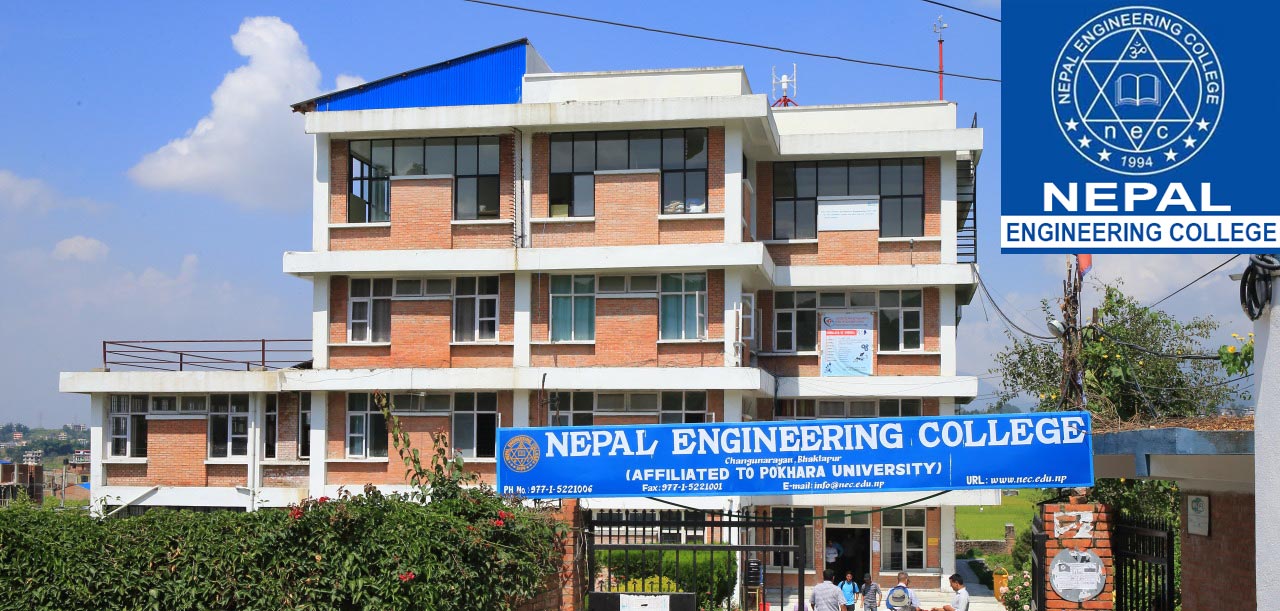
The 30-seat intake places TEAM within this specialized postgraduate setting rather than at the regular undergraduate campus in Changunarayan, Bhaktapur.
The program lasts two years and is organized into four semesters.
The M.Sc in Transportation Engineering and Management at Nepal Engineering College has an intake of 30 seats.
Students complete 60 credits: 45 credits of coursework and a 15-credit thesis.
Applicants need a Bachelor's degree in Civil Engineering with at least second division or 2.0 GPA from an institution recognized by Pokhara University.
Yes. An entrance test is required for Nepalese applicants.
The course is conducted at the nec Center for Postgraduate Studies, Prayag Pokhari, Lagankhel, Lalitpur.
The M.Sc in Transportation Engineering and Management at nec is affiliated with Pokhara University.
The curriculum includes Transportation Policy, Transportation Networking, Principles of Transportation Engineering, Traffic Engineering, Transport Planning Methods, Transportation Economics, Transport Planning Studio, Research Methods, Transport Safety, Organization Behavior and Human Resource Management, electives, and thesis.
Yes. Students complete Research Methods in Semester III and a 15-credit thesis in Semester IV.
The program is connected with transportation planning, traffic engineering, highway and transport infrastructure, transport policy, safety, operation, maintenance, management, and transportation research.






