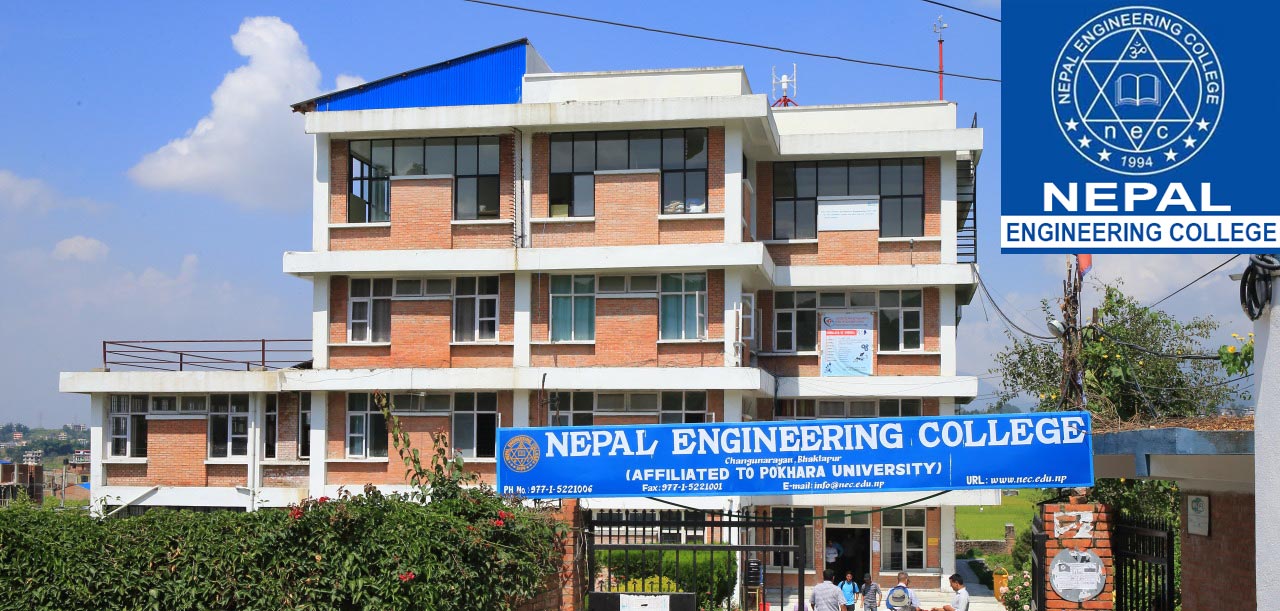
The Bachelor of Civil Engineering at Nepal Engineering College (nec) is a Pokhara University-affiliated undergraduate engineering program conducted at the college's main campus in Changunarayan Municipality-4, Bhaktapur. nec has offered Civil Engineering since 1994, and the program has an intake of 144 seats.
Civil Engineering at nec focuses on the planning, design, construction, operation, and maintenance of physical infrastructure and related services. Students study material engineering, structural engineering, environmental engineering, transportation engineering, water resources engineering, geotechnical engineering, surveying, construction management, and other areas that form the technical base of civil engineering.
The 2025 Pokhara University curriculum is arranged from Year I to Year IV across eight semesters. Students complete 129 credits, beginning with mathematics, science, mechanics, programming, engineering drawing, and basic engineering subjects before progressing to surveying, structures, geotechnical engineering, transportation, water resources, environmental engineering, construction management, project work, professional practice, and internship.
| Particular | Details |
|---|---|
| Course | Bachelor of Civil Engineering |
| Degree | Bachelor of Engineering (B.E.) |
| Institution | Nepal Engineering College (nec) |
| Affiliation | Pokhara University |
| Academic level | Bachelor's |
| Duration | 4 years |
| Academic structure | 8 semesters |
| Total credits | 129 |
| Intake | 144 seats |
| Study location | Changunarayan Municipality-4, Bhaktapur |
| Curriculum | Pokhara University Bachelor of Civil Engineering, 2025 |
| Internship | 6 credits in Semester VIII |
The course progresses in a clear sequence. The early semesters establish the mathematical, scientific, computing, drawing, and mechanics background needed for engineering study. The middle semesters introduce civil engineering materials, geology, fluid mechanics, surveying, soil mechanics, structures, hydraulics, hydrology, transportation, water supply, and foundation engineering. The later stages concentrate on design, construction management, environmental systems, hydropower, professional practice, projects, electives, and internship.
Civil engineering is concerned with physical infrastructure and the engineering work required throughout its life cycle. At nec, the program is structured around both theoretical and practical study rather than concentrating on one branch of civil engineering.
The principal areas identified within the program include:
material engineering;
structural engineering;
environmental engineering;
transportation engineering;
water resources engineering;
geotechnical engineering; and
surveying.
These areas become more specialized as students move through the eight-semester curriculum. The sequence also brings in engineering economics, construction project management, estimating and valuation, professional practice, projects, and internship, connecting technical study with project-level engineering work.
The course may suit students who have the required science and mathematics background and are interested in how infrastructure is surveyed, analyzed, designed, constructed, managed, operated, and maintained.
The curriculum requires sustained work with mathematics, mechanics, drawing, scientific concepts, calculations, surveying, engineering materials, structural behavior, soil and foundations, fluids and water systems, transportation, design, and project work.
Students considering the course should therefore be prepared for a combination of:
mathematical and analytical study;
engineering drawing and technical interpretation;
laboratory and practical work;
surveying and field-based activities;
structural and infrastructure design subjects;
project-based learning;
written technical communication;
engineering economics and management;
professional practice; and
internship.
The course is broader than structural engineering alone. Students encounter several branches of civil engineering before reaching the later semesters, where electives and project work provide room for more focused study.
For engineering programs under Pokhara University's Science and Technology area, candidates must have completed Grade 12 in the Science stream or an equivalent qualification from a recognized institution.
The stated academic requirements include:
completion of Grade 12 Science or equivalent;
study of Physics, Chemistry, and Mathematics, with the stated requirement of at least one course carrying a minimum of 100 full marks or 5 credits in these subjects;
a minimum C grade or 45% in each of Physics, Chemistry, and Mathematics;
an overall GPA of 2.0 on a 4.0 scale or equivalent; and
Mathematics of at least 100 marks in Grade 11 or Grade 12.
Pokhara University's undergraduate admission framework includes application submission, an entrance examination, merit ranking, and enrollment.
Applicants submit their academic and personal information through the applicable university or affiliated-college admission process. The application requirements identified for undergraduate admission include academic transcripts, a citizenship certificate, and passport-sized photographs.
Applicants then sit for an entrance examination conducted under the Pokhara University admission framework. Admission is merit-based, with ranking determined through entrance-examination performance. Final enrollment depends on merit and the availability of seats in the chosen program.
Nepal Engineering College has an intake of 144 seats for Bachelor of Civil Engineering.
The 2025 Bachelor of Civil Engineering curriculum contains 129 credits distributed over eight semesters. The course sequence gradually moves from foundation subjects toward specialized civil engineering study, design, projects, professional practice, and internship.
The first semester establishes the science, mathematics, computing, drawing, and mechanics base for later engineering study.
| Subject | Credit |
|---|---|
| Applied Chemistry | 2 |
| Applied Physics | 3 |
| Calculus I | 3 |
| Computer Programming | 3 |
| Engineering Drawing | 2 |
| Applied Mechanics (Statics) | 2 |
| Semester Total | 15 |
Students begin with mathematical and scientific concepts alongside programming, technical drawing, and statics. Engineering Drawing carries a substantial practical component, while Applied Chemistry, Applied Physics, and Computer Programming also include practical work.
The second semester introduces civil engineering materials and workshop study while extending mathematics, mechanics, electrical and electronics fundamentals, geology, and energy-related engineering knowledge.
| Subject | Credit |
|---|---|
| Algebra and Geometry | 3 |
| Applied Mechanics (Dynamics) | 2 |
| Basic Electrical and Electronics Engineering | 3 |
| Civil Engineering Materials | 2 |
| Civil Engineering Workshop | 1 |
| Engineering Geology | 3 |
| Introduction to Energy Engineering | 2 |
| Semester Total | 16 |
Civil Engineering Materials and Civil Engineering Workshop mark a shift from general engineering foundations toward subjects directly connected with the civil discipline. Engineering Geology also establishes geological knowledge required for later work in soil, foundations, infrastructure, and related areas.
By the third semester, the curriculum moves more firmly into civil engineering analysis and field-oriented study.
| Subject | Credit |
|---|---|
| Building Technology | 2 |
| Calculus II | 3 |
| Fluid Mechanics | 3 |
| Numerical Methods | 2 |
| Strength of Materials | 3 |
| Surveying I | 3 |
| Semester Total | 16 |
Strength of Materials introduces the behavior of engineering materials under load, while Fluid Mechanics begins the sequence of water-related engineering subjects. Surveying I introduces systematic measurement and fieldwork connected with civil engineering projects.
The fourth semester expands structural, geotechnical, hydraulic, surveying, communication, and project work.
| Subject | Credit |
|---|---|
| Project I | 1 |
| Hydraulics | 3 |
| Probability and Statistics | 2 |
| Communication Techniques | 2 |
| Soil Mechanics | 3 |
| Structural Analysis I | 3 |
| Surveying II | 3 |
| Semester Total | 17 |
Project I appears at this stage, alongside Surveying II. Soil Mechanics becomes the foundation for later geotechnical and foundation study, while Structural Analysis I begins the formal analysis of structural systems.
The third year brings together several of the main branches of civil engineering. Students move into hydrology, foundations, advanced structural analysis, transportation, water supply, concrete technology, irrigation, sanitation, engineering economics, and structural design.
| Subject | Credit |
|---|---|
| Engineering Hydrology | 2 |
| Survey Field Project | 1 |
| Foundation Engineering | 3 |
| Structural Analysis II | 3 |
| Transportation Engineering I | 3 |
| Water Supply Engineering | 3 |
| Concrete Technology and Masonry Structure | 3 |
| Semester Total | 18 |
The Survey Field Project provides a dedicated field component after Surveying I and Surveying II. Foundation Engineering builds directly on Soil Mechanics, while Structural Analysis II extends structural study from the previous semester.
Transportation Engineering I and Water Supply Engineering introduce two major infrastructure areas, while Concrete Technology and Masonry Structure addresses construction materials and structural applications.
| Subject | Credit |
|---|---|
| Engineering Economics | 3 |
| Design of Steel and Timber Structure | 3 |
| Elective I | 3 |
| Irrigation and Drainage Engineering | 3 |
| Sanitary Engineering | 3 |
| Transportation Engineering II | 3 |
| Semester Total | 18 |
Semester VI places greater attention on design and infrastructure systems.
Design of Steel and Timber Structure adds a structural design component, while Transportation Engineering II continues the transportation sequence. Irrigation and Drainage Engineering and Sanitary Engineering extend study in water and environmental infrastructure.
Engineering Economics introduces economic considerations relevant to engineering decisions and projects. The semester also includes the first elective.
The final year brings technical subjects together with project management, structural design, valuation, hydropower, professional practice, electives, project work, and internship.
| Subject | Credit |
|---|---|
| Project II | 3 |
| Construction Project Management | 3 |
| Design of R.C.C. Structures | 3 |
| Estimating and Valuation | 3 |
| Elective II | 3 |
| Hydropower Engineering | 3 |
| Semester Total | 18 |
Project II carries three credits and gives students a larger project component than Project I.
Construction Project Management introduces the management side of engineering projects. Design of R.C.C. Structures develops reinforced-concrete design study, while Estimating and Valuation addresses quantities and valuation within civil engineering work.
Hydropower Engineering extends the water-resources side of the curriculum, and Elective II provides another area of selected study.
| Subject | Credit |
|---|---|
| Elective III | 3 |
| Engineering Professional Practice | 2 |
| Internship | 6 |
| Semester Total | 11 |
The final semester is comparatively concentrated. Instead of carrying the same number of classroom subjects as earlier semesters, it includes a six-credit internship, Engineering Professional Practice, and the third elective.
The internship has 12 practical hours in the curriculum structure, giving the final semester a substantial practice-oriented component.
The complete 2025 structure carries 129 credits.
| Academic Stage | Credits |
|---|---|
| Semester I | 15 |
| Semester II | 16 |
| Semester III | 16 |
| Semester IV | 17 |
| Semester V | 18 |
| Semester VI | 18 |
| Semester VII | 18 |
| Semester VIII | 11 |
| Total | 129 |
The distribution reflects the way the course develops. The middle and later semesters carry heavier technical coursework, while the eighth semester reduces conventional classroom load and gives greater space to internship and professional practice.
Although the curriculum contains individual subjects, several larger areas run through the program.
Structural study develops through Strength of Materials, Structural Analysis I and II, Concrete Technology and Masonry Structure, Design of Steel and Timber Structure, and Design of R.C.C. Structures.
This sequence moves from understanding how materials and structural elements behave to analysis and later design-oriented courses.
Engineering Geology provides an early geological foundation. Soil Mechanics follows in Semester IV, and Foundation Engineering is taken in Semester V.
Together, these subjects address ground conditions, soil behavior, and foundations as part of civil engineering study.
Transportation Engineering I appears in Semester V and Transportation Engineering II in Semester VI.
Students who later want postgraduate study in this area may consider the M.Sc in Transportation Engineering and Management offered through nec's Center for Postgraduate Studies. Its stated entry background includes Civil Engineering.
The water and environmental sequence includes Fluid Mechanics, Hydraulics, Engineering Hydrology, Water Supply Engineering, Irrigation and Drainage Engineering, Sanitary Engineering, and Hydropower Engineering.
These subjects expose students to different stages of water movement, supply, drainage, sanitation, irrigation, and hydropower-related engineering.
Surveying begins with Surveying I, continues through Surveying II, and is followed by the Survey Field Project.
The sequence combines technical concepts with practical and field components, making surveying one of the clearly identifiable hands-on areas within the curriculum.
Construction-related learning appears across Civil Engineering Materials, Civil Engineering Workshop, Building Technology, Concrete Technology and Masonry Structure, Construction Project Management, Estimating and Valuation, Project I, and Project II.
Graduates interested in postgraduate management study may later consider the M.Sc in Construction Management. Civil Engineering is among the academic backgrounds identified for entry to that program.
The BE Civil curriculum does not separate theoretical study from practical work. Laboratory, tutorial, workshop, surveying, field, project, and internship components appear at different stages of the program.
Important practice-oriented components include:
Engineering Drawing;
Applied Chemistry and Applied Physics practical work;
Computer Programming practical work;
Civil Engineering Materials;
Civil Engineering Workshop;
Engineering Geology practical work;
Fluid Mechanics;
Strength of Materials;
Surveying I;
Project I;
Hydraulics;
Soil Mechanics;
Structural Analysis;
Surveying II;
Survey Field Project;
Foundation Engineering;
Transportation Engineering;
Water Supply Engineering;
Concrete Technology and Masonry Structure;
structural design subjects;
Project II; and
the six-credit Internship.
The curriculum also records lecture, tutorial, and practical requirements for individual courses, showing that the academic load is distributed across more than conventional lecture hours.
The finalized college context also places regular BE programs at the Changunarayan campus, where nec has Civil Engineering laboratory resources and includes two to three field visits or educational tours for BE and B.Arch. programs.
The curriculum can support development of skills in several connected areas, depending on a student's participation, academic performance, practical work, and project experience.
These may include:
engineering calculation and quantitative analysis;
technical drawing and interpretation;
computer programming fundamentals;
surveying and field measurement;
analysis of structural systems;
understanding of construction materials;
soil and foundation analysis;
transportation engineering analysis;
water supply and sanitation planning;
hydrology, hydraulics, irrigation, and drainage concepts;
estimating and valuation;
engineering project planning and management;
technical communication;
project work and reporting; and
workplace exposure through internship.
These are academic and practical learning areas within the curriculum rather than guarantees of professional competence immediately after graduation.
Project work appears at two different stages.
Project I is included in Semester IV and carries one credit. By this point, students have studied foundational mathematics, mechanics, materials, geology, fluid mechanics, strength of materials, surveying, hydraulics, soil mechanics, and introductory structural analysis.
Project II appears in Semester VII and carries three credits. It comes after students have progressed through advanced structural, geotechnical, transportation, environmental, water-resources, and construction-related courses.
This placement allows project work to develop alongside the increasing technical depth of the degree rather than being confined to the end of the program.
Internship is placed in Semester VIII and carries six credits. The curriculum assigns 12 practical hours to the internship component.
Its position in the final semester means students enter the internship after completing most of the program's technical subjects, including structures, transportation, water resources, geotechnical engineering, environmental engineering, construction project management, estimating and valuation, and major project work.
The internship is therefore an important part of the final academic stage rather than an optional addition outside the curriculum.
The stated purpose of the Civil Engineering program is to prepare graduates to deal with the design, construction, operation, and maintenance of physical infrastructure and services. Its curriculum covers structural, geotechnical, environmental, transportation, water resources, surveying, construction, and project-related areas.
Based on these areas of study, graduates may explore work connected with:
civil infrastructure;
structural engineering activities;
construction projects;
surveying;
transportation infrastructure;
water supply and sanitation;
irrigation and drainage;
hydropower-related civil works;
geotechnical and foundation work;
estimating and valuation; and
construction project coordination and management.
Career outcomes depend on a graduate's academic performance, technical ability, practical experience, professional requirements, location, employer needs, and available opportunities. The degree itself does not guarantee a particular position or employment outcome.
The course provides an academic base for advanced study in areas represented within the undergraduate curriculum.
At Nepal Engineering College, Civil Engineering graduates are specifically included among the eligible academic backgrounds for postgraduate study in Construction Management. Transportation Engineering and Management is also designed for applicants with a Civil Engineering background.
These options connect directly with subjects already encountered during the bachelor's degree, including Construction Project Management and Transportation Engineering I and II.
A student's choice of postgraduate field can depend on which parts of the bachelor's curriculum become most relevant to their interests, project experience, and longer-term academic direction.
The 2025 Bachelor of Civil Engineering structure gives a clear picture of how Pokhara University currently organizes the degree academically.
The program does not place all civil engineering subjects into the first year. Instead, it establishes prerequisites and then builds progressively:
science, mathematics, programming, drawing, and mechanics form the starting point;
materials, geology, fluids, strength of materials, and surveying follow;
structures, soil, hydraulics, foundations, transportation, hydrology, and environmental subjects develop in the middle semesters;
advanced design, construction management, valuation, hydropower, projects, professional practice, and internship appear later.
This sequencing matters for students because the course becomes increasingly specialized. Someone considering BE Civil should look at the complete eight-semester structure rather than judging the degree only from introductory subjects.
The course may be a reasonable academic match for a student whose interests align with mathematics, physical infrastructure, engineering analysis, surveying, construction, structures, transportation, water systems, or project-based technical work.
The curriculum demands more than an interest in buildings or construction. Students encounter chemistry, physics, calculus, mechanics, programming, statistics, geology, fluid behavior, soils, structures, surveying, environmental systems, transportation, economics, management, professional practice, projects, and internship.
Before choosing the course, students should consider whether they are comfortable with:
a four-year, eight-semester academic commitment;
mathematics and science-based subjects;
technical calculations and design work;
practical and field components;
surveying;
laboratory-oriented study;
project work;
a six-credit internship; and
study across several branches of civil engineering rather than only one specialization.
The 144-seat intake provides the institutional seat context, while admission remains tied to the applicable Pokhara University eligibility and entrance process.
The 2025 Pokhara University curriculum is structured across four academic years and eight semesters.
The complete Bachelor of Civil Engineering curriculum carries 129 credits.
Nepal Engineering College has an intake of 144 seats for Bachelor of Civil Engineering.
The Bachelor of Civil Engineering program at Nepal Engineering College is affiliated with Pokhara University.
Regular bachelor's programs at Nepal Engineering College are conducted at the main campus in Changunarayan Municipality-4, Bhaktapur.
The curriculum includes mathematics, science, mechanics, programming, engineering drawing, civil engineering materials, surveying, structures, soil and foundation engineering, transportation, water resources, environmental engineering, construction management, estimating and valuation, hydropower, projects, professional practice, electives, and internship.
Yes. Internship is included in Semester VIII and carries six credits.
Yes. Project I is included in Semester IV for one credit, while Project II is included in Semester VII for three credits.
Engineering applicants are required to complete Grade 12 Science or an equivalent qualification with the stated Physics, Chemistry, and Mathematics requirements. The academic criteria include at least C grade or 45% in each of these subjects and an overall GPA of 2.0 or equivalent.
Yes. The Pokhara University undergraduate admission framework includes an entrance examination, with admission based on merit and seat availability.
Civil Engineering graduates may continue into relevant postgraduate areas. At nec, Civil Engineering is an eligible background for M.Sc in Construction Management, while M.Sc in Transportation Engineering and Management is intended for applicants with a Civil Engineering background.