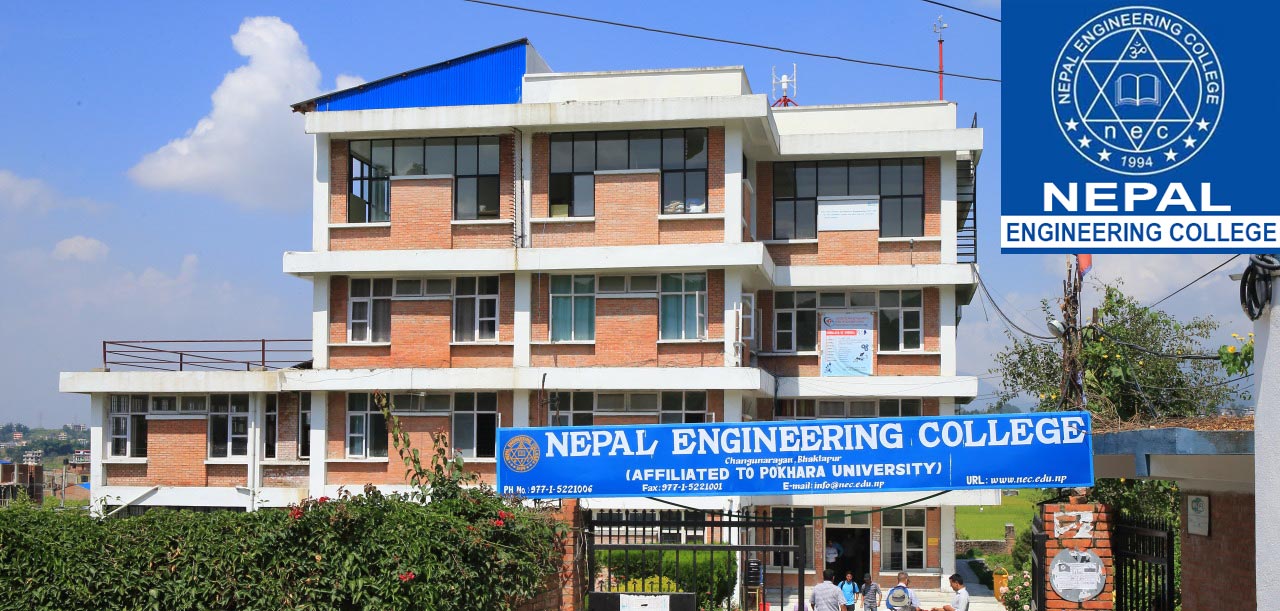
The Bachelor of Civil and Rural Engineering at Nepal Engineering College (nec) is an undergraduate engineering program affiliated with Pokhara University. The program is conducted at nec's main campus in Changunarayan Municipality-4, Bhaktapur, and has an intake of 48 seats.
nec started the Bachelor program in Civil and Rural Engineering in 2008. Its academic purpose connects civil engineering knowledge with rural infrastructure, natural resources, agriculture-related development, and services that influence rural communities. The program was developed around the relationship among technology, infrastructure, agriculture, and rural development.
The 2025 Pokhara University curriculum is organized across four academic years and eight semesters. It carries 131 credits and combines core civil engineering subjects with Rural Infrastructure, project work, surveying, water resources, transportation, structural and geotechnical engineering, professional practice, electives, and a six-credit internship.
| Particular | Details |
|---|---|
| Course | Bachelor of Civil and Rural Engineering |
| Institution | Nepal Engineering College (nec) |
| Affiliation | Pokhara University |
| Department | Department of Civil & Rural Engineering |
| Level | Bachelor's |
| Duration | 4 years |
| Academic structure | 8 semesters |
| Total credits | 131 |
| Intake | 48 seats |
| Study location | Changunarayan Municipality-4, Bhaktapur |
| Curriculum | Pokhara University Bachelor of Civil & Rural Engineering, 2025 |
| Internship | 6 credits in Semester VIII |
The degree retains the technical foundation of civil engineering while introducing rural infrastructure as a defined area of study. This makes the course relevant to infrastructure work where engineering decisions need to be considered alongside rural services, local resources, agriculture, and development conditions.
The Department of Civil & Rural Engineering places the course within Nepal's rural-development context. Its academic rationale recognizes links among agriculture, infrastructure, technology, services, natural resources, and the quality of rural life.
Students therefore study conventional civil engineering subjects while also developing an understanding of infrastructure in rural settings. The course is not limited to one type of construction or development activity.
The program's wider areas include:
civil infrastructure;
rural infrastructure;
surveying and field measurement;
structural engineering;
geotechnical and foundation engineering;
water resources;
transportation engineering;
water supply and sanitation;
construction management;
estimating and valuation;
hydropower engineering; and
engineering professional practice.
The rural component becomes explicit through Rural Infrastructure in Semester IV, while the overall program purpose connects engineering and technology with rural development.
For engineering programs under Pokhara University's Science and Technology area, candidates are required to have completed Grade 12 in the Science stream or an equivalent qualification from a recognized institution.
The academic requirements include:
study of Physics, Chemistry, and Mathematics;
at least one course of a minimum 100 full marks or 5 credits in Physics, Chemistry, and Mathematics;
a minimum C grade or 45% in each of Physics, Chemistry, and Mathematics;
an overall GPA of 2.0 on a 4.0 scale or equivalent; and
Mathematics of at least 100 marks in Grade 11 or Grade 12.
The college-level eligibility information also includes Diploma in Engineering or an equivalent qualification from a recognized institution with at least second division marks as an eligible academic background for bachelor's engineering study.
The 2025 curriculum contains 131 credits across eight semesters. The first year establishes mathematics, science, mechanics, programming, engineering drawing, materials, workshop practice, and basic electrical and electronics knowledge.
The second year introduces more specialized civil and rural engineering study. Surveying, fluid mechanics, structural mechanics, geology, hydraulics, soil mechanics, structural analysis, communication, project work, and Rural Infrastructure appear during this stage.
The third and fourth years develop advanced civil engineering subjects while retaining project, practical, professional, and field-oriented components.
| Semester | Main Subjects | Credits |
|---|---|---|
| I | Basic Electrical and Electronics Engineering, Calculus I, Applied Mechanics (Statics), Civil Engineering Materials, Computer Programming, Introduction to Energy Engineering | 15 |
| II | Algebra and Geometry, Applied Chemistry, Applied Mechanics (Dynamics), Applied Physics, Building Technology, Engineering Drawing, Civil Engineering Workshop | 15 |
The first year provides a common technical base for engineering study. Civil Engineering Materials and Civil Engineering Workshop introduce discipline-specific learning early in the program, while mathematics, mechanics, physics, chemistry, programming, and drawing support later analytical and design work.
| Semester | Main Subjects | Credits |
|---|---|---|
| III | Calculus II, Engineering Geology, Fluid Mechanics, Statistics and Numerical Methods, Strength of Materials, Surveying I | 18 |
| IV | Project I, Hydraulics, Communication Techniques, Rural Infrastructure, Soil Mechanics, Structural Analysis I, Surveying II | 18 |
Semester IV provides one of the clearest distinctions in the course through Rural Infrastructure. At the same stage, students continue with mainstream civil engineering study in hydraulics, soils, structures, and surveying.
Project I also appears in Semester IV, giving students an early project component before the more substantial Project II in the final year.
Semester V includes Concrete Technology and Masonry Structure, Engineering Hydrology, Foundation Engineering, Structural Analysis II, Survey Field Project, Transportation Engineering I, and Water Supply Engineering. The semester carries 18 credits.
Semester VI contains Design of RCC Structure, Elective I, Engineering Economics, Irrigation and Drainage Engineering, Sanitary Engineering, and Transportation Engineering II, also totaling 18 credits.
This stage brings several major infrastructure areas together. Students work with structural design, foundations, transportation, water systems, sanitation, irrigation, surveying, and engineering economics.
The Survey Field Project also provides a defined field component after students complete Surveying I and Surveying II.
| Semester | Main Subjects | Credits |
|---|---|---|
| VII | Construction Project Management, Design of Steel and Timber Structure, Elective II, Estimating and Valuation, Hydropower Engineering, Project II | 18 |
| VIII | Elective III, Engineering Professional Practice, Internship | 11 |
The final year moves toward project management, design, valuation, hydropower, professional practice, and workplace exposure.
Project II carries three credits and includes six practical hours in the curriculum structure. The final semester contains a six-credit internship with 12 practical hours, placing substantial emphasis on practical exposure at the end of the degree.
| Academic Year | Credits |
|---|---|
| Year I | 30 |
| Year II | 36 |
| Year III | 36 |
| Year IV | 29 |
| Total | 131 |
The curriculum gradually shifts from foundation subjects to applied civil and rural engineering. Its heavier middle years include structural, geotechnical, transportation, water-resources, surveying, environmental, and rural-infrastructure study before the final year concentrates more strongly on design, management, projects, professional practice, and internship.
The defining feature of the course is the connection between engineering and rural development.
The program was established in response to development issues associated with rural poverty, food insecurity, infrastructure, agriculture, services, and natural resources. Its academic direction recognizes that these areas can be closely linked rather than handled independently.
For a Civil and Rural Engineering student, this means infrastructure is considered not only as a technical construction problem but also in relation to the rural setting in which that infrastructure operates.
This orientation can be relevant to roads, water systems, rural services, natural-resource activities, agriculture-related infrastructure, and other development work where civil engineering knowledge needs to be applied within rural conditions.
The course contains practical work throughout the curriculum. Engineering Drawing, Civil Engineering Workshop, surveying, fluids, soil mechanics, structures, transportation, water-supply subjects, projects, and internship all include practical or field-oriented elements.
At nec, the academic facilities relevant to the program include a Civil & Rural laboratory. The college also has Civil, Computer, Electronic, and Electrical laboratories, while its library contains more than 40,000 books, journals, and magazines.
BE and B.Arch. programs at nec include two to three field visits or educational tours.
These resources fit the course's mixture of classroom engineering, field measurement, laboratory study, projects, and practical exposure.
Through the curriculum, students may develop skills related to:
engineering calculations and technical analysis;
surveying and field measurement;
understanding rural infrastructure;
structural analysis and design;
construction materials;
soil and foundation engineering;
transportation engineering;
water supply and sanitation;
irrigation and drainage;
hydrology and hydraulics;
estimating and valuation;
project planning and management;
technical communication; and
workplace practice through internship.
These are learning outcomes associated with the subjects and practical components of the course. Individual competence depends on academic performance, practical participation, project work, and experience.
The stated graduate areas for Civil and Rural Engineering include government and development agencies working in rural infrastructure development, natural resources management, agro-industries, and rural credit institutions, along with conventional Civil Engineering projects.
Graduates may therefore explore work connected with:
rural infrastructure development;
civil engineering projects;
natural resources management;
development organizations and agencies;
agriculture-related infrastructure;
transportation and road infrastructure;
water and sanitation projects; and
construction and project activities.
These are broad areas rather than guaranteed job outcomes. Career options depend on a graduate's skills, experience, academic performance, professional requirements, employer needs, location, and available opportunities.
Civil and Rural Engineering is specifically included among the eligible academic backgrounds for the M.Sc in Construction Management offered through nec's Center for Postgraduate Studies.
For that master's program, applicants from Civil Engineering, Civil and Rural Engineering, Hydropower Engineering, Bachelor of Architecture, or equivalent backgrounds are identified as eligible, subject to the stated postgraduate admission requirements.
This provides a documented postgraduate direction for graduates who later want to move toward construction and project management.
The program may suit students interested in civil engineering who also want to understand how infrastructure interacts with rural development, local services, natural resources, and agriculture-related conditions.
Students should be prepared for:
mathematics and science-based engineering study;
drawing and design work;
surveying;
laboratory and field activities;
structures and construction;
soil and foundation engineering;
water and transportation systems;
project work;
rural infrastructure study; and
a final-semester internship.
The course is especially distinct for students who want a civil engineering education that includes a defined rural-infrastructure perspective rather than focusing solely on conventional urban or general infrastructure work.