The Bachelor of Electronics and Communication Engineering at Nepal Engineering College (nec) is a bachelor's-level engineering program affiliated with Pokhara University. It is conducted through the Department of Electronics & Communication Engineering at the college's main campus in Changunarayan Municipality-4, Bhaktapur.
nec introduced its Bachelor's program in Electronics and Communication Engineering in the academic year 1999. The program has an intake of 96 seats and focuses on electronic circuits, electronic devices, and communication technologies. Its stated academic purpose is to develop students' ability to design, test, and apply electronic devices across applications ranging from household equipment to industrial systems and communication networks.
Electronics and communication technologies have developed through terrestrial, microwave, broadband, and other forms of communication. The program places students within this combined technical area, where electronic devices and circuits form the hardware base for transmitting, receiving, processing, and working with communication signals and systems.
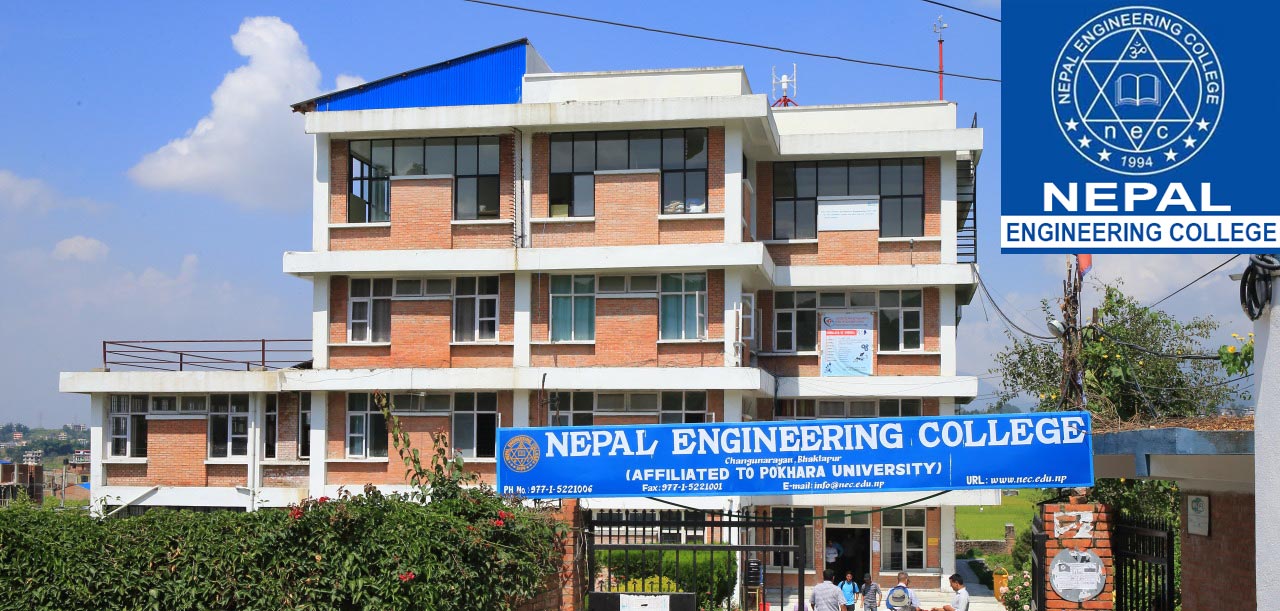
| Particular | Details |
|---|---|
| Course | Bachelor of Electronics and Communication Engineering |
| Degree | B.E. (Bachelor of Engineering) |
| Institution | Nepal Engineering College (nec) |
| Affiliation | Pokhara University |
| Department | Department of Electronics & Communication Engineering |
| Academic level | Bachelor's |
| Program started | Academic year 1999 |
| Intake | 96 seats |
| Study location | Changunarayan Municipality-4, Bhaktapur |
| Main academic area | Electronics and communication engineering |
Electronics and Communication Engineering is listed as a separate bachelor's engineering degree within nec's academic portfolio. The college also has Computer Engineering, Electrical and Electronics Engineering, and Information and Communication Engineering as separate programs, so these course titles should not be treated as interchangeable.
Electronics and Communication Engineering brings electronic devices and communication systems into one engineering field.
Electronic circuits and devices provide the technical foundation for many systems used to process, control, transmit, and receive information. Communication engineering addresses the systems and technologies used to move information between different points.
At nec, the program is presented around the need for engineers who can work with electronic circuits and devices for different communication requirements. Its academic direction includes the design, development, operation, maintenance, testing, and application of electronic devices.
This gives the program a technical scope that extends from individual electronic devices to larger communication applications.
The course is therefore relevant to students who want to study how electronic hardware and communication technologies work together rather than concentrating entirely on electrical power systems or software development.
The course centers on two closely connected areas: electronics and communication.
The electronics side deals with circuits, devices, and systems used in different technical applications.
The stated program objective includes developing competence to design, test, and apply electronic devices. The applications identified range from household gadgets to industrial systems and advanced communication networks.
This means students encounter electronics as an applied engineering area rather than only as a theoretical subject.
Their learning is connected with understanding how devices and circuits are designed, tested, used, and maintained within larger systems.
Communication forms the other major side of the degree.
The development of Electronics and Communication Engineering is described through communication technologies ranging from terrestrial systems to microwave and broadband communication.
Communication engineering is therefore not presented as one narrow technology. The program's academic context covers different generations and types of communication systems, requiring students to understand the electronic equipment that supports communication needs.
The connection between electronics and communication is central to the course. Communication systems depend on electronic circuits and devices, while electronic engineering provides the technical base needed to design, operate, test, and maintain those systems.
Electronic circuits and devices are a defined part of the program's stated academic purpose.
Students are prepared to work with electronic devices across several levels of application. These can range from comparatively small electronic products to equipment used within industrial and communication systems.
The focus on design and testing also gives the program an engineering character beyond simply operating electronic equipment.
The course may support the development of understanding related to:
electronic circuits;
electronic devices;
device design;
testing;
technical application;
operation of electronic systems; and
maintenance related to communication requirements.
These areas follow directly from the program's stated purpose and should not be interpreted as a complete semester-wise curriculum.
The course is situated within a field that includes terrestrial, microwave, and broadband communication technologies.
These terms indicate the range of communication environments connected with the discipline. Students studying Electronics and Communication Engineering therefore need to approach communication as a technical system supported by electronic hardware rather than only as information exchange.
The program's emphasis on different communication requirements also means students need to understand how electronic devices are applied within different types of communication systems.
This makes the degree distinct from courses that focus mainly on software, general information technology, or electrical power engineering.
The program may suit students who are interested in electronics and want to understand how electronic systems support communication technologies.
Students considering the course may find its academic direction relevant if they are interested in:
electronic circuits;
electronic devices;
communication systems;
technical design;
testing electronic equipment;
operation and maintenance of electronic systems;
microwave and broadband communication; and
the relationship between electronic hardware and communication networks.
The course requires an engineering-entry academic background, including mathematics and science.
It may be a more suitable academic direction for students who want to work closely with electronic hardware and communication systems than for those whose interest lies entirely in software programming or electrical power generation.
Pokhara University places Bachelor of Electronics & Communication Engineering within its Science and Technology engineering programs.
The stated engineering eligibility requirements include:
completion of Grade 12 in the Science stream or equivalent from a recognized institution;
study of Physics, Chemistry, and Mathematics;
at least one course carrying a minimum of 100 full marks or 5 credits in Physics, Chemistry, and Mathematics;
a minimum C grade or 45% in each of Physics, Chemistry, and Mathematics;
an overall GPA of 2.0 on a 4.0 scale or equivalent; and
Mathematics of at least 100 marks in Grade 11 or Grade 12.
The college's bachelor's eligibility information also includes Diploma in Engineering or an equivalent qualification from a recognized institution with at least second division marks.
Pokhara University's undergraduate admission framework includes application submission, an entrance examination, merit ranking, and enrollment.
Applicants submit personal and academic information and select their intended program through the applicable university or affiliated-college admission process.
The listed documents include:
academic transcripts;
citizenship certificate; and
passport-sized photographs.
Applicants must sit for an entrance examination conducted by Pokhara University or its affiliated colleges. The admission framework states that rankings are determined through entrance-examination performance, with successful applicants admitted according to merit and available seats.
The Bachelor of Electronics and Communication Engineering at nec has an intake of 96 seats.
The course is associated with the Department of Electronics & Communication Engineering.
The department accommodates Electronics and Communication Engineering as well as the separately identified Bachelor in Information and Communication Engineering.
The distinction between these programs matters.
Bachelor of Electronics and Communication Engineering has been offered since 1999 and is centered on electronic devices, circuits, and communication requirements.
Bachelor in Information and Communication Engineering is identified separately and combines core Electronics and Communication Engineering with Information Technology. Its described areas include electronic system design, communication technologies, programming, networking, machine learning, Internet of Things, and data systems.
Students should therefore compare the formal course names carefully when applying rather than assuming the two titles refer to the same degree.
Nepal Engineering College offers both Electronics and Communication Engineering and Electrical and Electronics Engineering, but they are separate programs.
Electrical and Electronics Engineering combines large-scale electrical systems with electronics. Its electrical side includes areas such as generation, transmission, and utilization of electricity.
Electronics and Communication Engineering places its stated emphasis on electronic circuits, devices, and communication requirements.
A student primarily interested in electrical power systems may therefore see a different academic direction in Electrical and Electronics Engineering, while a student interested in electronic devices and communication technologies may find Electronics and Communication Engineering more closely aligned with that interest.
The overlap in the word "electronics" does not make the two degrees equivalent.
Nepal Engineering College identifies an Electronic laboratory among the instructional resources available at its main campus. It also has Computer, Electrical, Civil, and Civil & Rural laboratories, along with an Architecture Design Studio.
The Electronic laboratory is directly relevant to a program concerned with circuits, devices, testing, and communication-related electronic systems.
The college library contains more than 40,000 books, journals, and magazines, providing a shared academic resource across the undergraduate programs.
nec also includes two to three field visits or educational tours for every BE and B.Arch. program.
For Electronics and Communication Engineering students, practical exposure complements the theoretical study of electronic devices and communication systems.
Based on the stated purpose of the program, students may develop abilities related to:
understanding electronic circuits and devices;
electronic device design;
testing electronic equipment;
applying electronic devices in different settings;
working with communication-related electronics;
understanding different communication technologies;
operating electronic systems;
identifying maintenance requirements; and
analyzing technical problems involving electronics and communication.
These are areas the course may develop through academic and practical study. Individual competence depends on academic performance, practical participation, technical practice, and experience.
The stated program rationale connects Electronics and Communication Engineering with the need for technical professionals who can design, develop, operate, and maintain electronic circuits and devices for different communication requirements.
Graduates may therefore explore technical work related to:
electronic devices and circuits;
communication systems;
electronic equipment testing;
operation of communication-related systems;
maintenance of electronic systems;
industrial electronic applications; and
communication-network equipment.
The course description also identifies applications ranging from household gadgets and industrial systems to advanced communication networks.
These areas describe possible professional directions rather than guaranteed employment. Career outcomes depend on technical ability, practical experience, academic performance, employer requirements, professional conditions, and available opportunities.
Electronics and Communication Engineering is most clearly understood as a hardware- and communication-oriented engineering program.
Students considering the course should think about whether they are comfortable with:
mathematics and science-based engineering study;
electronic devices and circuits;
technical design and testing;
communication technologies;
practical electronic systems;
working with hardware;
technical analysis; and
learning how communication equipment is designed, operated, and maintained.
Students should also distinguish the program from Computer Engineering, Electrical and Electronics Engineering, and Information and Communication Engineering because nec identifies each as a separate academic option.
For this course specifically, the defining points are its Electronics and Communication Engineering focus, its establishment at nec in 1999, its 96-seat intake, and its placement within the Department of Electronics & Communication Engineering.
Nepal Engineering College started its Bachelor's program in Electronics and Communication Engineering in the academic year 1999.
The program has an intake of 96 seats.
The Bachelor of Electronics and Communication Engineering at nec is affiliated with Pokhara University.
The program is conducted at Nepal Engineering College's main campus in Changunarayan Municipality-4, Bhaktapur.
The course is associated with the Department of Electronics & Communication Engineering.
The program focuses on electronic circuits and devices and their use in communication systems. Its stated purpose includes developing competence in designing, testing, and applying electronic devices.
The program description refers to the development of communication from terrestrial systems to microwave and broadband technologies.
No. They are separate bachelor's programs at nec. Electrical and Electronics Engineering includes large-scale electrical systems such as generation, transmission, and utilization of electricity, while Electronics and Communication Engineering focuses on electronic circuits, devices, and communication requirements.
No. nec identifies Bachelor in Information and Communication Engineering separately. That program combines Electronics and Communication Engineering principles with Information Technology, while Electronics and Communication Engineering retains its own degree identity.
Pokhara University engineering eligibility includes Grade 12 Science or equivalent with the stated Physics, Chemistry, and Mathematics requirements, including at least C grade or 45% in each subject and an overall GPA of 2.0 or equivalent.
Yes. The Pokhara University undergraduate admission framework includes an entrance examination, with admission based on merit and available seats.
Graduates may explore technical work involving electronic devices, communication systems, electronic equipment, industrial electronics, system operation, testing, and maintenance. Individual outcomes depend on skills, experience, employer needs, and available opportunities.