



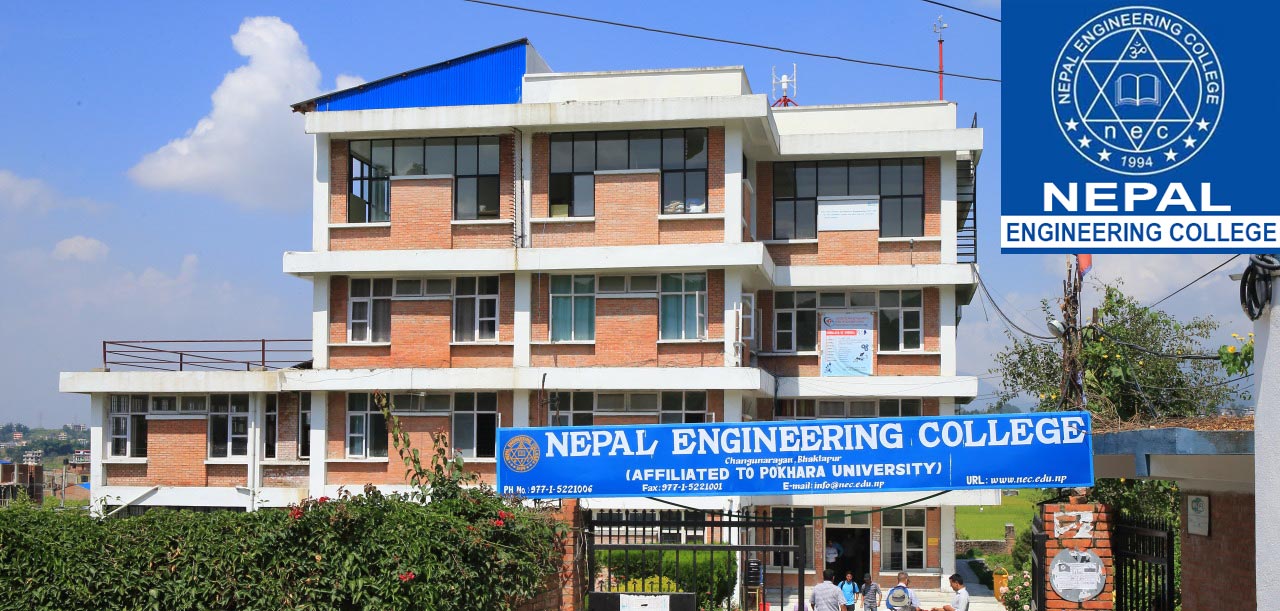
The M.Sc in Interdisciplinary Water Resources Management at Nepal Engineering College (nec) is a postgraduate program affiliated with Pokhara University. It is conducted through the nec Center for Postgraduate Studies (nec-CPS) at Prayag Pokhari, Lagankhel, Lalitpur.
The program was initiated in November 2007 to address water-resource issues through an interdisciplinary approach. Its academic structure connects hydrology and hydraulics with economics, society, public health, ecosystems, gender, law, policy, conflict, disaster risk, research, and the political dimensions of water management. Students complete 60 credits, including 44 credits of coursework and 16 credits of independent research.
| Particular | Details |
|---|---|
| Course | M.Sc in Interdisciplinary Water Resources Management |
| Short form | IWRM |
| Institution | Nepal Engineering College (nec) |
| Affiliation | Pokhara University |
| Academic level | Master's |
| Study location | nec-CPS, Prayag Pokhari, Lagankhel, Lalitpur |
| Academic structure | 4 semesters |
| Total credits | 60 |
| Coursework | 44 credits |
| Independent research | 16 credits |
| Intake | 30 seats |
| Program initiated | November 2007 |
Water-resource management involves more than technical knowledge of water flow. Decisions about water are also connected with livelihoods, public health, ecosystems, economic activity, law, policy, social inclusion, conflict, disasters, and political processes.
The IWRM program is structured around this wider relationship. Its aim is to develop graduates with interdisciplinary knowledge, theoretical understanding, and analytical skills for planning and managing water resources.
The program gives attention to:
management of water systems through an interdisciplinary perspective;
hydrology, ecology, pollution, and water use;
consumptive and non-consumptive uses of water;
water-induced disasters;
planning, development, and management of water resources;
social, economic, and environmental dimensions of water conflict; and
political processes connected with water acquisition, allocation, and use.
Applicants must hold a Bachelor's degree in Science and Technology, covering Engineering, Basic Sciences, Applied Sciences, or Natural Sciences, from a recognized university or institution.
A minimum second division or equivalent is required.
This broad entry base matches the interdisciplinary character of the course, which brings technical, environmental, social, economic, legal, and policy perspectives into water-resource study.
The curriculum is divided across four semesters and carries 60 credits. Coursework accounts for 44 credits, while 16 credits are assigned to independent research on a real field-based problem.
| Course | Credit |
|---|---|
| Hydrological Sciences | 3 |
| Water Flow and Hydraulics | 3 |
| Role of Water in Productive Activities | 3 |
| Society and Water: Public Health, Livelihood and Ecosystem | 3 |
| EIA and GIS application in Water Resources | 3 |
| Presentation, Writing and Reporting Skills | 2 |
| Total | 17 |
The first semester establishes both technical and social foundations. Hydrology and hydraulics sit alongside productive uses of water, public health, livelihoods, ecosystems, environmental assessment, GIS, and academic communication.
| Course | Credit |
|---|---|
| Economics of Water Resources Management | 3 |
| Gender, Water and Social Inclusion | 2 |
| Conflicts in Water Management | 3 |
| Legal and Policy Dimensions of Water Management | 3 |
| Water Induced Disasters and Risk Management | 3 |
| Total | 14 |
This semester shifts attention toward the institutional and human dimensions of water management. Economics, gender, social inclusion, conflict, law, policy, and disaster risk are treated as parts of water-resource decision-making rather than separate issues.
The third semester carries 13 credits and includes:
Integrated Water Resources Management — 4 credits
Field Research Methodology — 4 credits
Power, Authority and History — 2 credits
Elective — 3 credits
Integrated Water Resources Management and Field Research Methodology form the main academic components at this stage. Power, Authority and History adds a governance and decision-making perspective, while the elective provides space for selected study.
Semester IV is dedicated to the 16-credit IWM 700 Thesis.
The thesis represents the independent research component of the degree and is based on a real field-related problem. This gives research a substantial place within the overall 60-credit structure.
The course combines subjects that would normally sit across several academic fields.
Technical study appears through Hydrological Sciences, Water Flow and Hydraulics, and Water Induced Disasters and Risk Management. Environmental analysis is represented through EIA and GIS application in Water Resources.
The curriculum then adds subjects concerned with:
economics;
public health;
livelihoods;
ecosystems;
gender and social inclusion;
legal and policy questions;
conflict;
political authority;
research methodology; and
water-resource governance.
This mix is central to the program. Water management is approached as a technical, environmental, social, economic, legal, and political issue rather than only as an engineering subject.
Research accounts for 16 of the program's 60 credits.
Field Research Methodology in Semester III prepares students for research work, while the entire fourth semester is assigned to the thesis. The research component focuses on a real field-based problem.
Students may therefore develop experience in identifying water-related problems, organizing field research, interpreting information, and connecting technical findings with social, environmental, policy, or management concerns.
The curriculum may support the development of skills in:
water-resource analysis;
hydrological and hydraulic understanding;
environmental assessment;
GIS application in water resources;
water-resource economics;
conflict analysis;
policy and legal analysis;
disaster-risk assessment;
interdisciplinary problem analysis;
field research;
academic writing and reporting; and
planning and management of water resources.
These skills depend on a student's academic work, research participation, and performance throughout the program.
The program is intended to prepare graduates for planning and management functions related to water resources and for responding to water-management challenges through interdisciplinary analysis.
Graduates may explore work connected with:
water-resource planning and management;
watershed and water-system management;
environmental assessment;
water policy and governance;
water-related research;
disaster-risk management;
development programs involving water and livelihoods; and
organizations working with water, environment, public policy, or natural resources.
Career outcomes depend on academic background, research experience, technical and analytical skills, employer requirements, and available opportunities.
All postgraduate programs of Nepal Engineering College are conducted through the nec Center for Postgraduate Studies at Prayag Pokhari, Lagankhel, Lalitpur. The center is also the academic location for Construction Management, Natural Resources Management, and Transportation Engineering and Management.
For IWRM students, the postgraduate setting is directly connected with coursework and research rather than the regular bachelor's engineering environment at the Changunarayan campus.
The program was initiated in November 2007.
The program carries 60 credits in total.
Students complete 44 credits of coursework and 16 credits of independent research.
The academic structure is divided into four semesters.
The M.Sc in Interdisciplinary Water Resources Management has an intake of 30 seats.
Applicants need a Bachelor's degree in Science and Technology, including Engineering, Basic Sciences, Applied Sciences, or Natural Sciences, with at least second division or equivalent from a recognized university or institution.
The program is conducted at the nec Center for Postgraduate Studies in Prayag Pokhari, Lagankhel, Lalitpur.
Yes. Semester IV consists of the 16-credit IWM 700 Thesis.
The curriculum includes hydrology, hydraulics, water economics, public health and livelihoods, EIA and GIS, gender and social inclusion, water conflict, law and policy, disaster risk, integrated water resources management, research methodology, and power and authority.






