



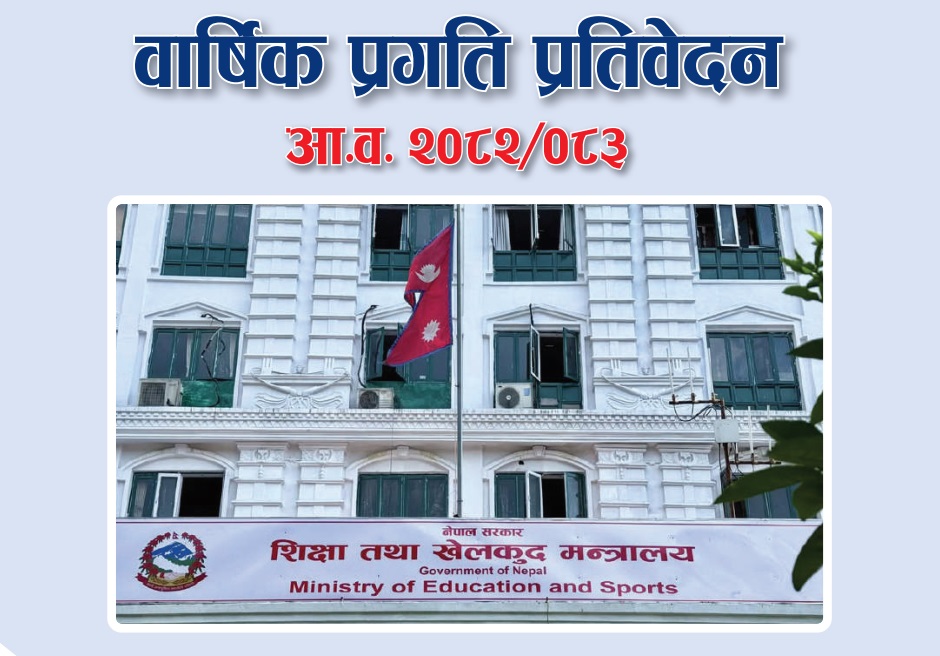
Education Ministry Releases FY 2082/83 Annual Progress Report: 81.52% Financial Progress, Education Indicators Improve
Kathmandu: The Ministry of Education and Sports has released its Annual Progress Report for Fiscal Year 2082/83, covering the implementation of policies, plans and standards related to education and sports, along with programs aimed at improving the education sector.
Published by the ministry’s Planning and Monitoring Division, the report provides detailed information on work carried out by the ministry and its subordinate agencies, budget expenditure, education statistics, examination results, existing challenges and efforts made to address them.
According to the report, major areas covered for FY 2082/83 include implementation of the education and sports budget, student enrolment and retention from school to higher education, development of educational infrastructure, and achievements in the sports sector.
Budget Allocation and Financial Progress
The total revised budget allocated to the education and sports sector for FY 2082/83 was Rs 224.60304 billion. The largest share of the total budget was transferred to local levels through fiscal transfers.
According to the report, 66.87% of the total budget, or Rs 150.20284 billion, was allocated to local levels, while 2.19%, or Rs 4.9264 billion, went to provincial levels, and 30.93%, or Rs 69.4738 billion, was allocated at the federal level.
The report separately states that of the Rs 67.3704 billion allocated at the federal level, Rs 61.14108 billion was allocated for recurrent expenditure and Rs 6.231324 billion for capital expenditure.
The ministry reported expenditure of 88.32% of the recurrent budget and 54.12% of the capital budget at the federal level, resulting in overall financial progress of 81.52%.
According to the Economic Survey 2082/83, the education sector’s contribution to Nepal’s gross domestic product is estimated at 9.22%, compared with 8.86% in the previous fiscal year. Although gross value added in the education sector is projected to expand by only 1.50% during the current fiscal year, its estimated contribution to GDP is expected to increase.
School Education and Student Statistics
Data for academic session 2082 show that the net enrolment rate at the basic level reached 97.7%, while the rate at the secondary level stood at 51.2%.
The gender parity index was 1.02 at the basic level and 0.90 at the secondary level. According to the report, this indicates higher participation of girls than boys at the basic level, while a gender gap remains at the secondary level.
The student survival rate stood at 86.5% through Grade 8, 66.9% through Grade 10 and 39.3% through Grade 12. The report notes that although retention has improved at the basic level, a substantial number of students still leave the education system before completing the secondary level.
A total of 35,951 schools were operating across the country in academic session 2082. The report states that around 71.27% (27,010) were community and religious schools, while 24.87% (8,941) were institutional schools.
There were 1,387 religious schools, accounting for 3.9% of the total, with Lumbini Province recording the highest number at 555.
Compared with academic session 2081/82, the total number of schools declined by 504. The number of community schools fell by 288, while the number of institutional schools increased by 792.
Of all students currently enrolled, 62.2% study in community schools and 37.8% in institutional schools.
In academic session 2082, a total of 7,040,825 students were enrolled in Grades 1–12. Of them, 5,374,272 were studying at the basic level (Grades 1–8) and 1,666,553 at the secondary level (Grades 9–12).
Boys accounted for 52.3% of total enrolment and girls for 47.7%.
Teachers and Student-Teacher Ratios
A total of 272,456 teachers were working at the basic and secondary levels across all types of schools. Of them, 121,891, or 44.73%, were women and 150,565, or 55.26%, were men.
Women accounted for 55.03% of teachers at the basic level, while men represented 79.31% of teachers at the secondary level.
Student-teacher ratios in community schools vary considerably by level. Based on approved teaching positions, the ratio is 1:23 in Grades 1–5 and 1:45 in Grades 6–8.
At the secondary level, particularly Grades 11–12, the ratio based on approved positions is 1:60. When all categories of teachers are included, the ratio is 1:50, indicating a shortage of teachers at the upper level.
Early Childhood Development and Education
Nepal has 42,619 Early Childhood Development and Education (ECED) centres, of which 34,356 are community or government-run centres.
A total of 1,220,538 children were enrolled in these centres during academic session 2082/83, including 55.1% boys and 44.8% girls.
Among students entering Grade 1, 77.5% had previous early childhood development experience.
Information Technology in Schools
Among community schools operating across the country, 85.4% have internet access, while ICT laboratories have been expanded to 29.6% of schools, or 18,617 schools.
Including electricity supplied through alternative sources, 79.1% of community schools have access to electricity.
Examination Results and Student Learning Achievement
Secondary Education Examination 2082
A total of 512,471 candidates participated in the Grade 10 Secondary Education Examination (SEE).
Among 430,667 regular candidates, 65.98%, or 284,160 students, received grades, while 34.02%, or 146,507 students, were classified as non-graded (NG).
The proportion of students receiving grades increased by 4.17 percentage points compared with the previous year.
Grade 12 Results
A total of 418,170 regular candidates appeared in the Grade 12 examination.
Of them, 64.13%, or 268,190 candidates, received grades in all subjects, while more than 140,000 students were classified as non-graded.
Among regular candidates, the proportion obtaining a GPA between 3.61 and 4.00 increased to 5.35%, representing 17,786 students, compared with the previous year.
National Assessment
According to a study conducted by the Educational Quality Testing Center, the proportion of students achieving minimum learning standards in mathematics, Nepali, science and English in Grades 5 and 10 remains comparatively low.
In Grade 5, only 22% of students in mathematics, 51% in Nepali, 53% in science and 44% in English achieved the minimum learning standard.
Higher Education and Study Abroad
Student enrolment in higher education increased by 10.9% to 745,770.
Management accounts for the largest share of higher education enrolment, with 50.5% of students, while agriculture has the lowest share at 0.15%.
Of all higher education students, 75.3% are enrolled at Tribhuvan University.
Nepal currently has 21 universities, including 15 federal and six provincial universities, as well as eight health sciences academies.
The number of higher education institutions receiving Quality Assurance and Accreditation (QAA) certification through the University Grants Commission has reached 132, an increase of 15.79% compared with the previous year.
Study Abroad
During FY 2082/83, 114,924 students obtained No Objection Certificates (NOCs) for study abroad. The report notes that the number remains high compared with the previous year.
In medical education, eligibility letters for foreign study were issued to 498 undergraduate students, 82 postgraduate students, and a total of 621 students across undergraduate, postgraduate, fellowship and PhD categories.
Major Achievements by Agencies
1. Ministry-Level Activities
An Organization and Management (O&M) survey of the ministry and its subordinate agencies was completed.
A total of 1,141 complaints received through Hello Sarkar were addressed.
Regarding audit irregularities, a total of Rs 460 million was submitted for settlement after regularisation and recovery, of which around Rs 440 million, or 61.97%, was settled.
The ministry also renewed 760 institutions providing educational consultancy services.
An Ordinance to Amend Some Nepal Acts Related to Universities, 2083 was drafted.
2. Department of Education
The department, which is responsible for implementing school education projects, worked on educational quality and infrastructure development.
-
Day meal program: Rs 10.19 billion was allocated to provide day meals to children from early childhood education through Grade 5, benefiting around 2.8 million students.
-
Scholarships: Rs 1.83 billion was allocated and distributed for school-level scholarships, Rs 50 million for technical education and Rs 560 million for higher education.
-
Free textbooks: Free textbooks were provided to students from Grades 1–12, with digital copies also made available.
-
Literacy: Kalikot was declared a literate district during the year, bringing the total number of literate districts to 68. Five provinces—Koshi, Gandaki, Bagmati, Sudurpashchim and Lumbini—have been declared literate. Lumbini Province was declared literate with a 96.16% literacy rate among people aged 15–60.
-
Teacher training: Around 33,000 school teachers received training on using the Sikai Chautari portal, while 25 officer-level employees completed in-service training.
3. University Grants Commission
The University Grants Commission carried out various activities to improve the quality of higher education and promote research.
Among proposals received from community campuses across the country, 389 campuses were selected for grants.
The commission approved 25 proposals for physical development, 59 for equipment procurement and 33 for libraries, while grants were provided to a total of 583 campuses.
A total of 78 students were enrolled and studying at Madan Bhandari University of Science and Technology.
Regulations related to Joint and Dual Degree Programs were approved and forwarded to universities.
4. Council for Technical Education and Vocational Training
The Council for Technical Education and Vocational Training (CTEVT), which provides skills-based training in line with labour-market demand, implemented special programs for poor and marginalised communities.
A total of 1,030 trainees enrolled in 24-month training programs.
According to a tracer study, 75% of those who completed the training were employed, with average monthly earnings above Rs 28,000.
Under co-investment arrangements with industries, 1,553 workers received skills-upgrading training.
5. Teachers Service Commission
The Teachers Service Commission conducted advertisements and examinations for permanent teacher recruitment and recommended 356 candidates at the secondary level and 624 at the lower-secondary level for permanent appointment.
A total of 58,857 teaching licences were issued across the secondary and lower-secondary levels.
Through internal competition and performance evaluation, 1,838 teachers were recommended for promotion appointments.
6. Medical Education Commission
The Medical Education Commission determined seat numbers, conducted on-site monitoring and managed entrance examinations for undergraduate and postgraduate, including DM/MCh, academic programs.
The syllabus for physics, chemistry and biology was updated for the integrated undergraduate entrance examination.
7. National Examinations Board
The National Examinations Board (NEB), which has primary responsibility for conducting Grade 10 and Grade 12 examinations and publishing results, prepared guidelines to facilitate examinations for candidates with disabilities and forwarded them to the ministry.
Grade 10 annual examination results were published within 29 days, while Grade 12 results were published within 40 days.
The online system for issuing equivalence certificates was also streamlined.
8. Curriculum Development Center
The Curriculum Development Center developed and revised curricula for 17 secondary-level subjects.
It also developed and revised textbooks for 28 subjects, including optional mathematics, business studies, accounting, economics and environmental science.
For mother-tongue education, curricula and textbooks were developed in languages including Magar Dhut, Awadhi, Doteli, Bantawa Rai, Chamling Rai, Nepal Bhasa and Limbu.
For the technical stream, 20 learning-resource materials covering five subject areas in Grade 11 were developed.
9. Educational Quality Testing Center
The center deployed external evaluators to conduct performance assessments of 100 community secondary schools in 31 local levels.
A pre-assessment of early-grade reading and mathematical skills among 3,765 students from 251 schools in 15 districts was also completed.
National assessments under NARN and NASA for Grades 5, 8 and 10 were conducted, and related reports were prepared.
10. National Kitabkhana (Teachers)
The office completed registration of service records for 555 permanent teachers.
Pension, gratuity and family pension services were provided to 3,899 teachers and family members.
Software for the E-Pension system covering post-retirement benefits was updated.
Property declarations of 100,342 permanent teachers were recorded and submitted to the National Vigilance Center.
11. Libraries
-
Kaiser Library: Services were provided to 87,353 readers and researchers. Around 36,500 pages were scanned in preparation for updating the electronic library. Old tables damaged by the earthquake were repaired and returned to service.
-
Dilliraman Kalyani Regmi Library: More than 400 old books were digitised, while 7,450 people used its services. The Dr. Dilliraman Regmi National and International Peace Award 2082 was also presented.
-
Nepal National Library: Work was carried out to prepare a national bibliography containing details of materials published within Nepal. Library-management training was provided to 20 participants from six districts, while 38,865 readers received services.
12. National Sports Council and Nepal Scouts
The National Sports Council participated in 192 international competitions, in which Nepal secured 51 gold, 22 silver and 19 bronze medals.
Cash awards totalling Rs 108.348 million were provided to 104 medal-winning athletes and officials.
Under Mission 2026, 120 athletes from 10 sports were placed in special training programs targeting the 20th Asian Games.
A total of 119 national-level competitions involving 30,000 athletes were organised.
Nepal Scouts provided training to 696 people and mobilised 23,175 volunteers for activities including fairs, disaster management and tree plantation.
National Pride Projects and Reconstruction
Reconstruction After Earthquakes and Disasters
Reconstruction of most schools damaged by the 2015 earthquake in 31 districts has been completed.
This includes reconstruction of around 49,000 classrooms in 7,677 schools, 3,459 toilets and 2,170 drinking-water facilities.
Reconstruction work on an additional 14 schools has begun with grant assistance from the Government of India.
However, reconstruction of 39 constituent colleges of Tribhuvan University, which was expected to be carried out with Exim Bank loan assistance, has yet to begin.
Of the 839 schools damaged by the 2080 BS earthquake in Jajarkot and Rukum West, reconstruction is underway on 29 school buildings with loan assistance from the Asian Development Bank, 11 with JICA support and 99 with GPE/UNICEF support.
National Pride Sports Projects
-
Mulpani Cricket Academy, Kathmandu: The project’s revised estimated cost is Rs 7.4924 billion, while total expenditure to date stands at Rs 192.3 million. Rs 200 million was allocated in the FY 2082/83 budget. However, the tender process could not proceed because the budget was frozen and approval for a multi-year tender had not been obtained. Physical progress during the fiscal year stood at only 7%.
-
Girija Prasad Koirala Cricket Stadium, Biratnagar: The project’s revised estimated cost is Rs 3.6463 billion. Although Rs 160 million was allocated during the fiscal year, the ministry said the tender could not be invited because the budget was frozen and approval for a multi-year tender had not been obtained.
Existing Problems and Efforts to Address Them
The report also identifies common problems faced by the ministry and its subordinate agencies.
Key challenges include failure to complete work against designated milestones on time, difficulties in implementing programs funded through fiscal transfers, delays in receiving progress reports, capital expenditure remaining below target, and financial progress failing to match physical progress in some programs.
Projects have also been affected by delays in acquiring land for school infrastructure and establishing the necessary legal basis for construction.
For national pride projects, major challenges include budget allocations below the amounts required under approved Detailed Project Reports, failure to secure funding commitments needed for multi-year tenders, and unresolved issues involving a road, drinking-water pipeline and management of squatter encroachment within the Mulpani stadium area.
The ministry said these issues have been under continuous discussion and review through meetings of the Senior Management Team (SMT) and the Ministerial Development Action Committee (MDAC).
Software for budget and program allocation and progress reporting has been developed and brought into operation, while agencies are being instructed and facilitated to improve implementation.
According to the report, matters that are difficult to resolve at the ministry level are submitted to meetings of the National Development Action Committee (NDAC).


Comments 0
No comments yet. Be the first to start the conversation.