




Nepal’s Universities: Only Certificate Factories?
The most complex and bitter question rising in today’s young generation is this: “Is the university degree we earned after years of effort only a worthless piece of paper?”
After observing Nepal’s education sector closely for two decades, I have seen disappointment and anger in the eyes of thousands of students. When a student completes a Bachelor’s or Master’s degree and steps into the job market, they may hold a certificate in their hand—but they often lack the skills the market demands and even the confidence to move forward.
The result is visible in the long lines of young people at the departure lounge of Tribhuvan International Airport.
Universities are supposed to be “temples of knowledge,” yet they are increasingly accused of turning into administrative offices that only “conduct exams and publish results” (often not on time). But is this accusation 100% true? Or are there deeper problems behind it that we fail to see?
Let us analyze this by standing on facts, logic, and practical reality.
Table of Content
- Nepal’s Universities: Only Certificate Factories?
- The Depth of the Problem
- Are All Universities Bad? (Balanced, Evidence-Based View)
- Its Impact on Society and the Nation (Deep Impact Analysis)
- Practical Solutions: What Is the Way Forward?
- Conclusion
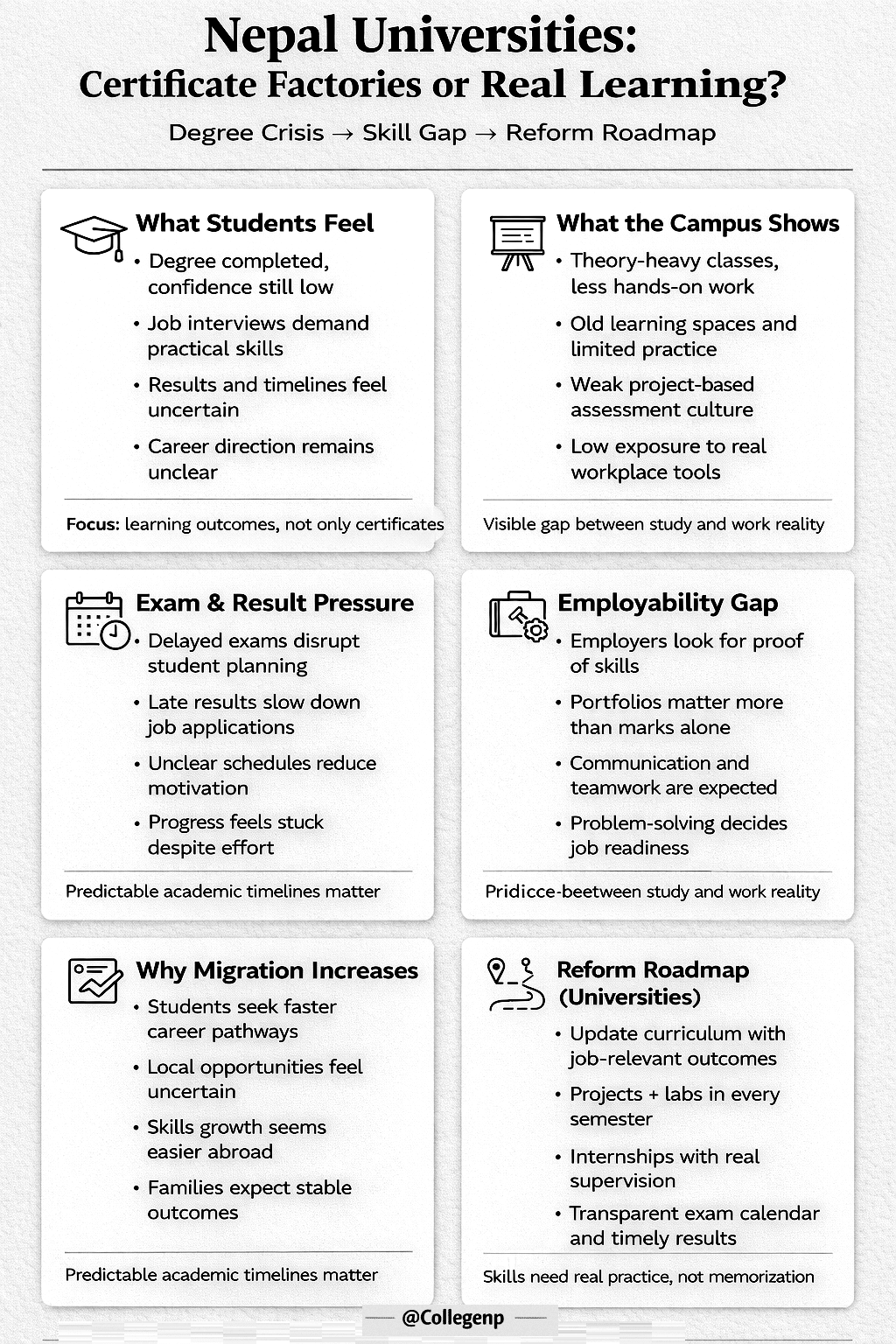
The Depth of the Problem
The narrative of “certificate-printing factories” did not form out of thin air. There are solid reasons and evidence behind it. As a responsible analyst, I will attempt to examine the root causes here.
A) Outdated Curriculum and Rote Learning
The biggest disease of our higher education system is the lack of a curriculum that matches the times. Today’s world is driven by artificial intelligence, data science, and the global economy. Yet, in many universities, curricula are 10–15 years old.
Fact: In some subjects under Management and Humanities, students are studying theories that are no longer used in today’s corporate world.
Problem: Our evaluation system is based not on “how much a student understands,” but on “how much they can memorize” (a memory test). A three-hour exam is expected to measure four years of effort.
This forces students to become rote learners instead of creative thinkers.
B) Lack of Research Culture
Top universities in the world (such as Oxford and Harvard, or IITs in neighboring countries) are known for producing new knowledge (knowledge creation). But most universities in Nepal only distribute existing knowledge (knowledge distribution).
Analysis: A university’s core responsibility is to find solutions to society’s problems through research. However, only a very small share of university budgets is spent on research in Nepal.
Many professors feel pressured to write “journal papers” mainly for promotion, even when such writing has little connection with society or industry.
Until a university becomes a true “think tank,” it will continue to feel like a “printing press.”
C) Disorder in the Academic Calendar
This is one of the most embarrassing aspects of Nepal’s higher education, especially in large universities. For many students, it feels almost like “a divine message” to know when exams will happen and when results will come.
Reality: It has become normal for a four-year course to take five to six years to complete. When exam results do not arrive for up to 18 months, it directly plays with students’ futures.
This wasted time pushes students toward frustration, mental stress, and migration abroad. This is a pure management failure.
D) The Academia–Industry Gap
There is no alignment between the workforce the market demands and the workforce universities produce.
Examples:
-
Banks need employees who understand FinTech, but colleges still teach traditional banking.
-
IT companies need cloud computing knowledge, but curricula still focus on outdated coding.
Result: Students have degrees, but not employability (job readiness). Employers complain, “We can’t find skilled manpower,” while students struggle saying, “We can’t find jobs.”
Are All Universities Bad? (Balanced, Evidence-Based View)
As a responsible editor and long-time analyst, I can confidently say this: “Putting everyone in the same basket is intellectual dishonesty.”
Even if the “certificate factory” narrative often appears true, “islands of excellence” still exist within Nepal’s higher education system.
If Nepal’s universities were completely useless, our graduates would not receive full scholarships at top global universities like Harvard, MIT, and Oxford. Nepalis would not be present in NASA or Silicon Valley either.
This section must be examined through three main dimensions.
A) Brand Value and Global Recognition (The Legitimacy of IOM and IOE)
Even if Tribhuvan University (TU) faces many serious management questions, two of its technical institutes—the Institute of Medicine (IOM) and the Institute of Engineering (IOE), Pulchowk—have maintained a standard that is considered exemplary across South Asia.
Evidence and analysis: Pulchowk Campus is often seen as a “mini-IIT” in South Asia. The entrance exam difficulty level and selection process are so fair and transparent that no one can reasonably question the caliber of students who graduate from there.
Global impact: Hundreds of doctors who completed MBBS from IOM have achieved strong results in the USMLE (United States) and PLAB (United Kingdom). This confirms that the foundation of our curriculum and pedagogy is fundamentally strong.
If these institutions were only “certificate-printing machines,” their graduates would not receive recognition (accreditation) from international medical councils.
B) Kathmandu University (KU): A Management Benchmark
Kathmandu University has proven that Nepal can implement a functional academic calendar and that “education free from political interference” is possible.
Data: At KU, more than 95% of examinations happen on time, and delays in publishing results are rare.
International relations: KU runs student exchange and joint research programs through collaboration with universities in Norway, the United States, and across Europe. In particular, graduates from the School of Management (KUSOM) and the School of Science have become key contributors to Nepal’s corporate and research sectors.
This shows one clear point: the problem is not “Nepal’s soil,” but TU’s outdated administrative system.
C) Specialized Colleges and “Value Addition” (Private Sector and Niche Colleges)
Even when university curricula are outdated, some private and community colleges have done remarkable work through “value addition.”
Non-credit course practice: Top IT and management colleges in the Kathmandu Valley have understood that university syllabi alone are not enough. They make professional certifications (such as AWS, Cisco, and Digital Marketing) essential for students.
Incubation centers: Some colleges have built their own startup incubation centers. Students turn classroom theory into prototypes inside labs.
While the university may only demand 35% pass marks, these colleges invest additional resources to make students job-ready.
D) Potential in Agriculture and Forestry Science
Agriculture and Forestry University (AFU), Rampur, and forestry science institutes in Hetauda have carried out meaningful research in Nepal’s unique climate, medicinal herbs, and agricultural systems.
Examples include the development of new rice varieties and forest management models. The technical graduates produced by these institutions have become drivers of agricultural transformation in remote regions of Nepal.
Therefore, saying “all universities are ruined” is only an expression of despair, not reality.
The truth is this:
“We have world-class students and some world-class institutes, but the system and leadership running them are outdated.”
Our struggle should not be to erase universities, but to institutionalize best practices and reform what is broken. If Nepal can connect KU’s management discipline, IOM’s quality, and the private sector’s readiness, higher education can take a major leap.
Its Impact on Society and the Nation (Deep Impact Analysis)
When universities fail, it is not only the failure of an educational institution—it becomes an “eclipse” over the nation’s future.
In 20 years of experience, the most frightening picture I have seen is how university mismanagement slowly breaks the backbone of a country.
Its impact is multidimensional and long-term, and it can be analyzed through three main points.
A) Not “Brain Drain,” but “Intellectual Hemorrhage”
We often use the term “brain drain” too lightly. Looking at trends and evidence, it is no longer just a drain—it has become a hemorrhage that can push a nation into a state of crisis.
Alarming data: According to recent figures from the Ministry of Education’s No Objection Certificate (NOC) branch for foreign study approval, more than 100,000 youths receive permission to leave the country each year.
This is not only about those going to study. It includes those who have lost hope in the system and concluded, “Nothing will happen here.”
Loss of demographic dividend: Countries achieve development leaps through their active youth workforce (15–40 years). Nepal is currently in that “golden window.”
But when universities fail to deliver timely exams and results, this energetic human resource ends up working in supermarkets and gas stations abroad. Nepal is losing the biggest human capital of its history, and much of it may never return.
B) Economic Burden and Capital Flight
University failure hits Nepal’s economy from two directions.
Capital flight: Along with students, billions of rupees in foreign currency flow out of the country. According to Nepal Rastra Bank data, the annual outflow in the name of education worsens the trade deficit.
Zero return on domestic investment: Middle-class families who keep their children in Nepal spend lakhs for a four-year course (which often takes six years). Sometimes they even sell land to fund education.
But after six years, the graduate may enter the job market with a salary of only NPR 15,000–20,000 per month. In economic terms, this is a negative return on investment.
This has weakened the financial stability of middle-class families and reduced their purchasing power.
C) A “Culture of Waiting” and Social Decay
University delays create a dangerous “culture of waiting” in society.
Psychological impact: When students are forced to wait up to 18 months for results, frustration and anxiety rise sharply. This prolonged uncertainty can fuel social risks, including substance abuse and increasing self-harm cases, which must be viewed alongside educational instability.
Underemployment: Students hold certificates but lack practical skills. This produces underemployment. Even Master’s graduates often fail to get work matching their qualifications and are forced into low-wage jobs.
This creates cynicism: “What is the point of studying?” When educated groups lose trust in the state and system, the seeds of rebellion and chaos are planted in society.
When universities delay printing certificates or distribute low-quality certificates, students pay with their time, and the nation pays with its future.
This is not only an education issue—it is a serious crisis linked to national security and existence.
Practical Solutions: What Is the Way Forward?
Complaints alone do not solve problems. Based on 20 years of experience, I propose the following practical solutions for policymakers, universities, and students.
A) Suggestions for Universities and the Government
Curriculum Overhaul:
-
A mandatory mechanism should ensure curriculum review every 2–3 years.
-
Curriculum committees should include 50% representation from industry leaders, businesses, and employers so that market needs are clearly reflected.
Investment in Research:
-
Theses must be freed from “copy-paste culture” and made fieldwork-driven and problem-solving focused.
-
At least 20% of a university’s budget should be allocated to research.
Strict Academic Calendar:
-
Technology should be used to make the examination system efficient.
-
Through digitization, a binding rule should be enforced to publish results within three months.
Faculty Quality:
-
Professors need regular training and industry exposure.
-
If the educators themselves are not updated, how can students become updated?
B) Suggestions for Students (Most Important)
Do not sit and wait for the university to improve before you become something. This is your life.
Focus on skills, not just certificates:
-
Universities give degrees. You must build skills yourself.
-
Learn new skills in your field through online platforms like Coursera, Udemy, and edX.
Internships and networking:
-
Do not wait until graduation to search for jobs.
-
Develop the habit of learning while studying.
-
Do volunteering, because it gives real-world experience.
Soft skills:
-
Focus on communication, problem solving, and leadership development.
-
These skills may not be written in textbooks, but they matter the most in real life.
Conclusion
So, are Nepal’s universities only certificate-printing factories?
Not completely. But if the same traditional patterns, political division (in administrative appointments), and outdated curricula continue, it will not take long for this accusation to become reality.
A university is not built by buildings and benches. It is built by the academic debates, research, and innovation that happen inside it.
Nepal does not need graduates who only hang certificates on walls. Nepal needs citizens who can solve problems.
For this, universities must change their modality, and students must prioritize capability over degree.
If you are a student, parent, or policymaker reading this, remember:
The purpose of education is not only to fill the brain, but to open it and sharpen it.
Let us ask questions, apply pressure, and begin reform from our own positions.
Also Read
Education System in Nepal: Structure, Challenges and Solutions
Nepal’s Education History: Ancient to Modern Analysis
Nepal Administrative System: History, Federalism, Reforms
Nepal’s Administrative Reform: AI and Predictive Rights
AI Era and Nepal’s Education: Challenges and Reform Plan
Why Nepal’s University Quality Is Always Questioned







Comments 0
No comments yet. Be the first to start the conversation.