




Higher Education in Nepal – A Serious Review and a White Paper for Transformation
Title: Why Are Questions Always Raised About the Quality of Nepal’s Universities? (From the Root of the Problem to the Peak of Solutions)
I have closely observed Nepal’s education sector for a long time—from the last bench of the classroom to the policy-making table. I have seen both hope and disappointment in the eyes of thousands of students.
When I see dust-covered books in Tribhuvan University’s library, or when I meet students in the Far-West and Mid-West studying science without laboratories (labs), one serious question strikes me:
“What kind of generation are we preparing?”
Today’s article is not political blame-game or superficial talk. It is a mirror for the younger generation—where we will look at the real face of our universities and draw a practical map for how it can be improved.
I will not speak of any “magic wand.” Instead, I will reveal those bitter truths—because without fixing them, our future cannot be secure.
Table of Content
- Higher Education in Nepal – A Serious Review and a White Paper for Transformation
- Chapter 1: Landscape and Contradiction
- Chapter 2: The Curriculum Gap
- Chapter 3: Teaching Method – From “Notes” to “Exams”
- Chapter 4: Research – The Lost Soul of the University
- Chapter 5: Governance and Structural Flaws
- Chapter 6: The Crisis of Infrastructure, Technology, and Academic Ambience
- Chapter 7: The Economic Disconnect and the Vicious Cycle of Unemployment
- Chapter 8: The Roadmap to Solution
- Conclusion
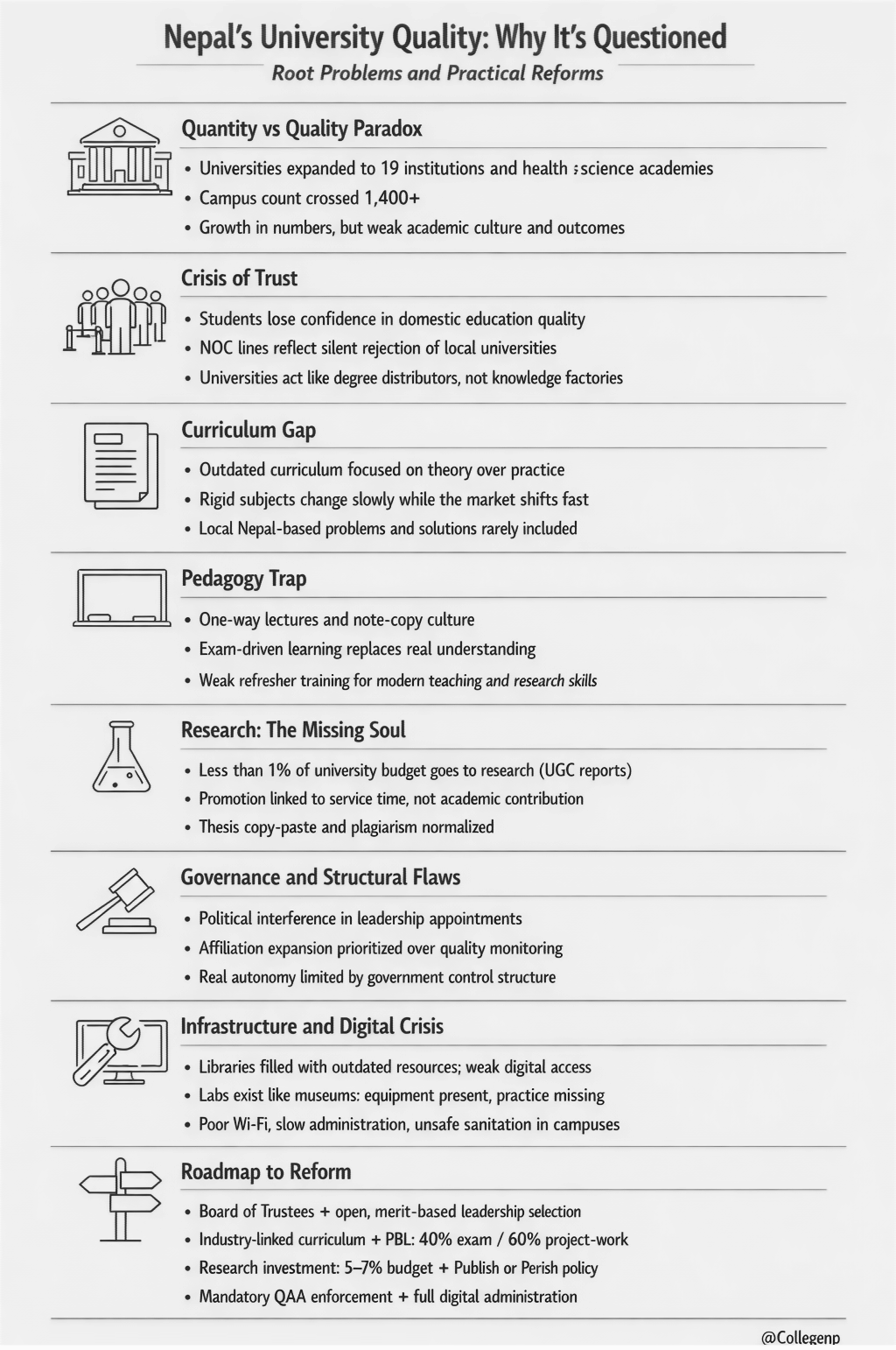
Chapter 1: Landscape and Contradiction
When we look at the history of higher education in Nepal, we have made a quantitative leap, but in terms of quality, we are where we were—or even pushed backward.
Our journey began with Tribhuvan University, established in 2016 B.S., and has now expanded to 19 universities and health science academies. The number of campuses has crossed 1,400.
From the statistics, it looks like Nepal is becoming an educational hub. But what is the reality?
Crisis of Trust
The most frightening fact is that Nepali students’ trust in education within their own country has almost ended.
The long lines of thousands of students at the Ministry of Education’s “No Objection Letter” (NOC) section represent a silent yet powerful revolt against the quality of our universities.
When a country’s youth cannot see their future in domestic universities, it must be understood that the education system there has already failed.
We opened universities and built buildings, but we could not build a “university culture.” A university is not merely a postal office that distributes degrees; it is a factory that produces knowledge.
But our universities remained limited to repeating old knowledge (dissemination of old knowledge) rather than creating new knowledge (creation of knowledge).
Chapter 2: The Curriculum Gap
One of the major reasons behind the declining quality of Nepal’s universities is an “outdated curriculum.”
1. Heavy theory, dry practice
Our curriculum is built with a 1990s mindset. For example, a management student studies marketing theory, but does not know about digital marketing, data analytics, or the practical use of artificial intelligence (AI).
An engineering student sits through long exams on outdated technologies, but cannot operate modern software used in the market.
Our curriculum trains students to memorize “What is?” but does not teach “How to do?” and “Why to do?”
2. Rigidity
In the world’s best universities, curricula are flexible. A student can study physics along with music, or computer science along with psychology.
But in our system, the subject structure is as rigid as “iron beaten rice.” The market changes every 3 months, but our curriculum takes 10 years to change.
By the time the revised curriculum arrives, that technology has often become irrelevant.
3. Lack of local relevance
Nepal is missing from our curriculum. We study American or European case studies, but rarely find courses that explore Nepal’s water resources, herbs, tourism, or agriculture-based real problems and solutions.
As a result, students earn degrees, but they do not understand Nepal’s own soil and realities.
Chapter 3: Teaching Method – From “Notes” to “Exams”
Go into any average campus classroom, and the scene looks the same as 20 years ago.
Teachers stand in front and lecture. Students listen (or sleep). In the end, they copy “notes.”
So where is the problem?
One-way communication
Teaching should be a two-way dialogue. But here, a student who asks questions is considered “showing off.”
Critical thinking is discouraged.
Exam-centered learning
A whole year of learning gets squeezed into a 3-hour exam. Students study not for knowledge, but to pass.
This has created the culture of “guide books” and “guess papers.” The one who can memorize well is considered excellent, while the one who understands but cannot memorize is marked as a failure.
Teacher capacity
Most teachers are still teaching the same “notes” they studied 20 years ago.
There is almost no effective system of refresher training to update teachers in modern pedagogy, technology use, and research.
Chapter 4: Research – The Lost Soul of the University
According to German educationist Humboldt’s concept, teaching and research are two sides of the same coin. But in Nepal, universities became only “teaching centers.”
Evidence-based analysis
If we look at the reports of the University Grants Commission (UGC), less than 1% of the total university budget is spent on research.
Most of the budget is consumed by salaries, allowances, and administrative costs.
Professors are not required to do research or publish in journals. Their promotions are based on time served (service duration), not on academic contribution.
In many cases, students’ theses or research papers have become “copy-paste” products or items that can be purchased from the market. This has normalized plagiarism (intellectual theft).
Until a university produces new knowledge, it cannot rise above the level of a “higher secondary school.”
Today, Nepal faces problems like waste management, traffic congestion, and economic stagnation. How many practical solutions have universities produced for these issues?
The answer is disappointing.
Chapter 5: Governance and Structural Flaws
The main root of declining quality in Nepal’s universities lies in their governance model.
1. Political interference (Politicization)
There should be no hesitation in writing this: our universities have turned into playgrounds for the sister organizations of political parties.
From vice-chancellor, rector, and registrar to campus chief appointments, “power-sharing” matters more than merit (qualification).
When leadership comes through political blessing, it becomes accountable not to the university, but to political leaders.
This damages the academic environment, leads to lockouts, and disrupts the academic calendar.
2. Affiliation Raj (Affiliation farming)
Instead of improving the quality of their constituent campuses, universities often show more interest in distributing affiliations to private colleges.
There are frequent complaints about financial dealings and lack of transparency in the affiliation process.
Due to weak monitoring mechanisms, a trend has grown where colleges operate by hanging a university board in a flat.
3. Lack of autonomy
Even though universities are called autonomous on paper, in practice they remain under government control.
The system where the Prime Minister becomes Chancellor and the Education Minister becomes Pro-Chancellor makes universities look more like government departments than academic institutions.
Globally, it is rare for an executive Prime Minister to serve as Chancellor and chair university meetings.
Chapter 6: The Crisis of Infrastructure, Technology, and Academic Ambience
Education quality does not depend only on curriculum and professors. It also depends on where and in what kind of environment education is delivered.
If infrastructure is the “hardware” of education, Nepal’s universities are operating on near-collapsed hardware—where no modern “software” (teaching methods) can function well.
1. Library: a center of knowledge or a “graveyard of books”?
Libraries, considered the heart of universities, are in a miserable state.
By international standards, university libraries should provide students access to the latest global research and journals (JSTOR, IEEE, Elsevier, etc.).
But even by 2026, our libraries still display piles of 1990s books—termite-eaten and outdated beyond context.
The concept of a “digital library” is limited to a signboard.
When students cannot find sources to understand the latest global trends, they are forced to depend on Wikipedia or cheap market guidebooks.
This prevents students from becoming researchers and turns them into memorizers.
Libraries should be quiet and inspiring, but in many campuses they are dark, cramped rooms.
2. Laboratory: a museum you can see, but cannot touch
The backbone of science and technology is practical lab work. But many government campus labs have become like museums.
Equipment exists, but an invisible “Do Not Touch” sign seems to hang everywhere.
-
Lack of materials: When chemistry students want to experiment, the required chemicals are out of stock.
-
Technology gap: Engineering students practice on machines that the industry replaced 20 years ago.
As a result, our engineers and scientists become strong theoretically, but weak practically.
Becoming an engineer without touching machines is like becoming a swimmer without touching water.
3. Digital divide and the illusion of “smart campus”
We talk about “Smart Nepal,” but as soon as you enter universities, it feels like time has gone 20 years backward.
Students carry 5G phones in their pockets, but the classroom is ruled by dusty chalk and erasers.
Administrative hardship also reflects this lack of infrastructure. Even in today’s digital age, students must stand for hours in lines to get transcripts, fill registration forms, or obtain simple recommendations.
Without effective use of Learning Management Systems (LMS), communication between students and universities remains primitive.
Connectivity is not a luxury. Wi-Fi is a basic academic right. But in many campuses, internet access is limited to administrative offices, not available to students.
4. Environmental psychology and minimum human dignity
The most shameful issue is campus cleanliness and basic facilities.
Many constituent campuses face extreme shortages of clean toilets and drinking water.
For female students, the lack of safe and hygienic sanitation facilities affects health and even classroom attendance.
This is not only an academic issue—it is an issue of minimum human dignity.
Also, university walls should be decorated with educational posters and research charts. Instead, they are often painted with ugly slogans, weapons, and threatening language of political party sister organizations.
This sends a message into students’ subconscious mind: “This is not a place to study, it is a place to fight.”
Until university premises are transformed from a “political battlefield” into an “academic garden,” the dream of quality improvement will remain incomplete.
Chapter 7: The Economic Disconnect and the Vicious Cycle of Unemployment
The most painful aspect of Nepal’s higher education is the disconnect between its economic model and the job market.
Parents invest lifetime savings, ancestral property, or high-interest loans to educate their children up to bachelor’s or master’s levels.
A typical middle-class family invests around NPR 10 to 15 lakhs in a private college.
By basic economic logic, return on investment (ROI) should come within a certain time.
But the irony is this: after spending 15 lakhs to study engineering or management, students struggle even to secure a monthly salary of 15,000.
This turns education from an investment into a sunk cost.
1. The chasm between degree and competence
The broken link between universities and industry has created a severe skill mismatch.
Universities are strong at making students memorize facts and theories—things that can be found on Google with one click.
But the market does not seek facts; it seeks skills.
-
Lack of hard skills: IT companies complain that computer engineering graduates cannot do basic coding. Banks say MBA toppers cannot practically analyze a balance sheet.
-
Absence of soft skills: Employers complain more about soft skills than technical knowledge. Communication, teamwork, time management, and problem-solving abilities are extremely weak among our graduates.
The curriculum treats these skills as “outside the curriculum,” while modern workplaces consider them the most essential.
2. Industry’s compulsion and external dependency
On one side, unemployment is increasing. Youth carry certificates and stand in lines at the passport office.
On the other side, Nepal’s major industries, construction projects, and corporate houses import technical and managerial manpower from neighboring countries (especially India), claiming “skilled manpower was not found.”
Why this contradiction?
Because for industries, hiring a Nepali university fresher means paying salary for the first 6 months while also paying retraining costs.
Industries want ready-to-work manpower, which our universities have failed to produce.
As a result, a large share of Nepal’s labor market and remittance flows outside, while our youth are forced to go to Gulf countries as low-skilled workers.
3. Underemployment and devaluation of certificates
More frightening than unemployment is underemployment.
A youth with a master’s degree in sociology or international relations, after finding no options, is forced to ride a bike on a ride-sharing app or work as a basic accounting assistant in a shop.
This not only hurts self-respect, but also causes credential inflation—the devaluation of academic certificates.
When people with PhDs or master’s degrees must compete for jobs like Khardar or Subba, society’s perception of education itself becomes negative.
4. Building social hopelessness
Because of this economic imbalance, a dangerous narrative has formed among the youth:
“What is the use of studying?”
“There is no future in Nepal.”
This narrative is not created from the air. It is built from watching thousands of seniors struggle with degrees in hand.
When education cannot guarantee economic security, no law or patriotic slogan can stop brain drain.
This economic disconnect is the main reason today’s youth have stopped seeing their future in universities.
Chapter 8: The Roadmap to Solution
It is not enough to only talk about problems.
As a responsible editor and expert, I present here a blueprint of reforms that must be carried out immediately and in the long term.
This is not imaginary. It is based on global practices and Nepal’s realities.
1. Governance reform: the “Board of Trustees” model
-
Abolish the system where the Prime Minister is Chancellor: Universities must be fully left to academic leadership.
-
Form a Board of Trustees: Instead of the Prime Minister or ministers, establish a board including respected scholars, educationists, and civil society leaders.
-
Open competition: Appointments should not be based on political sharing, but on open competition, vision paper presentations, and public hearings.
2. Radical curriculum transformation: “innovation” and “skills”
-
Industry collaboration: Curriculum committees must include mandatory representation from industry, business, and employers.
-
Credit transfer and flexibility: Students should have freedom to choose subjects. Policies like earn while you learn should be implemented practically.
-
Project-based learning (PBL): 40% evaluation through written exams and 60% through project work, presentations, and fieldwork.
3. Research-focused universities
-
Budget allocation: The state and universities must spend at least 5–7% of the total budget on research and development (R&D).
-
Publish or Perish: Professors’ promotions must be mandatorily linked to their research and publications.
-
Research fund: In collaboration with the private sector, create a Research Fund that can invest in students’ startup ideas.
4. Strict enforcement of quality assurance (QAA)
The Quality Assurance and Accreditation (QAA) system run by UGC must be made mandatory and strict.
Regulators must have the courage to cancel affiliations of campuses that fail to meet standards.
5. High use of technology (Digital Transformation)
Classrooms must be made smart, every student must have access to digital libraries, and university administrative work (admission, results, transcripts) must be fully online and automated.
The situation where students wait 6 months for results must end immediately.
6. The role of students and parents
Students must stop studying only for degrees. They must ask questions, learn new skills, and make themselves competitive.
Parents must learn to respect fields beyond only “doctor/engineer,” and also respect their children’s interests (passion).
Conclusion
It is natural that questions are raised about the quality of Nepal’s universities, because the results are in front of us.
But this does not mean the situation must remain the same forever.
Reforming universities is not about painting buildings. It is about changing mindsets.
We need universities where a student’s mind opens upon entry, and where they leave not with just a certificate, but with skills and confidence to compete globally.
This is not impossible.
Some departments of Kathmandu University and certain practices in medical education prove that quality is possible even within Nepal.
What is needed now is willpower.
Political leadership must stop treating universities as vote banks, and the academic community must abandon a “job-holder mentality.”
Finally, my message to young readers: this country and its institutions belong to us.
Running away or only criticizing will not solve problems.
Let us ask questions, remain alert, and make efforts for improvement from our own positions.
Until our education improves, our nation cannot improve.
This is a battle for quality, and a battle for our existence.
Also Read
Education System in Nepal: Structure, Challenges and Solutions
Nepal’s Education History: Ancient to Modern Analysis
Nepal Administrative System: History, Federalism, Reforms
Nepal’s Administrative Reform: AI and Predictive Rights
AI Era and Nepal’s Education: Challenges and Reform Plan
Nepal’s Universities: 21st Century Problems and Solutions






Comments 0
No comments yet. Be the first to start the conversation.