



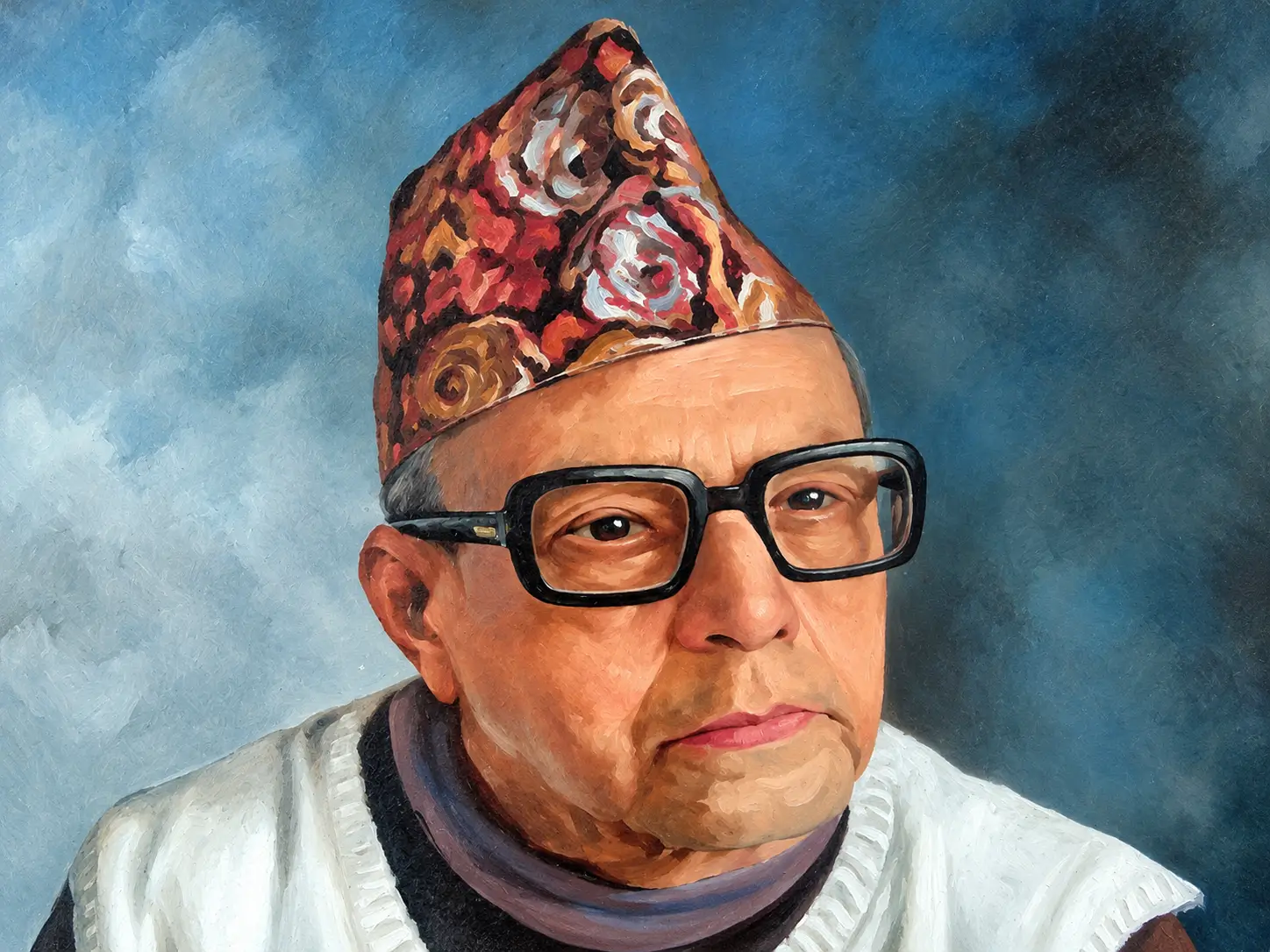
Ramesh Bikal (BS 1985 Kartik 29 – BS 2065 Poush 2) was a Nepali short story writer, novelist, children's literature author, playwright, and essayist. Known for his social realism and progressive literary outlook, Bikal explored economic inequality, class discrimination, rural life, child psychology, and human emotions in his writings.
Born Rameshwar Chalise, Bikal began his public literary career in BS 2006 with the publication of his short story Garib (Poor) in the monthly literary magazine Sharada. He wrote across several genres, including short stories, novels, plays, one-act plays, essays, travel writing, autobiography, and children's literature.
Bikal received the Madan Puraskar for BS 2018 for his short story collection Naya Sadak ko Geet. His novel Aviral Bagdachha Indrawati is a significant work of Nepali social realist fiction. Beyond creative writing, he was involved in teaching, educational material development, editing, painting, and the development of literary institutions.
Ramesh Bikal: Biography at a Glance
|
Particulars |
Details |
|---|---|
|
Literary name |
Ramesh Bikal |
|
Birth name |
Rameshwar Chalise |
|
Date of birth |
BS 1985 Kartik 29 |
|
Place of birth |
Arubari, Gokarna, Kathmandu |
|
Date of death |
BS 2065 Poush 2 |
|
Father |
Chandra Shekhar Chalise |
|
Mother |
Chhaya Devi |
|
Spouse |
Sushila Chalise |
|
Educational qualifications |
BA and BEd |
|
First published short story |
Garib (BS 2006) |
|
First short story collection |
Birano Deshma (BS 2016) |
|
Major short story collections |
Birano Deshma, Naya Sadak ko Geet, Aaja Feri Arko Tanna Ferinchha, Urmila Bhauju |
|
Major novels |
Sunauli, Aviral Bagdachha Indrawati, Sagar Urlanchha Sagarmatha Chhun |
|
Major awards |
Madan Puraskar (BS 2018), Mahendra Pragya Puraskar (BS 2038) |
|
Literary characteristics |
Social realism, progressive consciousness, and psychological portrayal |
|
Other professional activities |
Teaching, editing, painting, and leadership in literary institutions |
Birth, Family Background, and Childhood
Ramesh Bikal was born on BS 1985 Kartik 29, the day of Bhai Tika, in Arubari, Gokarna, Kathmandu district. His father was Chandra Shekhar Chalise, and his mother was Chhaya Devi.
According to the official records of the Madan Puraskar Guthi, his birth name was Rameshwar Chalise, and his family nickname was Rambabu. Other literary studies also mention his name as Rameshwar Sharma Chalise and Rameshwar Prasad Chalise. However, he became widely known in Nepali literature by his literary name, Ramesh Bikal.
His childhood was marked by family difficulties. According to literary critic Professor Dr. Khagendra Prasad Luitel, Bikal lost his mother when he was approximately one and a half to two years old and was subsequently raised under his father's care. His grandmother also died when he was five.
Because his father worked in government service, the family had to live in different places due to his employment. This gave Bikal opportunities to experience Nepal's diverse geographical and social settings during childhood.
After his father's death during his adolescence, Bikal had to assume additional family responsibilities. Although these circumstances affected his education, he continued his studies and creative activities.
The social inequalities, rural life, and family difficulties he experienced from childhood later appeared in various forms throughout his literary works.
Education and Intellectual Development
Ramesh Bikal's early education began at home. He received his first lessons in reading and writing from his grandfather, Pandit Ghananath. During his early education, he studied religious texts, including Rudri, Chandi, and Durga Kavach.
His schooling was interrupted by frequent changes of residence associated with his father's government employment. Nevertheless, he continued pursuing formal education.
According to Professor Dr. Luitel's study, Bikal passed the civil service examination of the time in BS 2005. He subsequently passed the School Leaving Certificate (SLC) examination in BS 2011.
He pursued higher education and obtained BA and BEd qualifications.
Alongside formal education, Bikal developed interests in literature, society, art, and music. His experiences of different social conditions in the places where he lived appear to have helped broaden his knowledge and literary outlook.
Professional Career: Government Service, Teaching, and University Education
Ramesh Bikal's professional career included government service, school teaching, educational material development, editing, and university-level teaching. Although he worked in different institutions, he continued writing literature throughout his professional life.
Beginning of Government Service
In BS 2006, Ramesh Bikal entered government service as a nausinda at Kathmandu Customs.
He subsequently worked in various government publication and education-related institutions. In BS 2018, he served as an assistant editor in the Department of Publicity.
His government service exposed him to administrative structures, the lives of government employees, and the social conditions of the time.
School Teaching
Ramesh Bikal was also involved in school education.
Professor Dr. Luitel's study mentions that he taught at Vinayak Middle School in Chabahil, Kathmandu.
His teaching experience and close involvement with children's learning appear to have influenced his educational writing and contributions to children's literature.
Educational Material Development and Editing
In BS 2021, Bikal joined the Educational Materials Writers' Centre as a section officer. The institution later developed into an organizational structure associated with the Janak Education Materials Centre.
He worked in this field until BS 2033. He then served as a section officer in the Examination Section of the Ministry of Education until BS 2035.
Until BS 2045, he worked as an editor in the Primary Materials Unit of the Primary Education Project.
Through these responsibilities, Bikal remained actively involved in preparing, writing, and editing educational materials.
Teaching at Tribhuvan University
Ramesh Bikal also taught at Tribhuvan University.
From BS 2046 to BS 2051, he served as a lecturer on a contract basis at the Central Department of Nepali, Tribhuvan University.
During this period, he taught the Nepali language to international students.
His involvement in government service, school education, editing, and university teaching formed an important part of his professional career.
Beginning and Development of His Literary Career
Ramesh Bikal's public literary career began in BS 2006 with the publication of his short story Garib.
Before this, he had written poems and other literary pieces for handwritten magazines. However, Garib, published in the Chaitra issue of the monthly magazine Sharada in BS 2006, is regarded as his first publicly published literary work.
The story addresses economic inequality in rural society, problems associated with debt, and the exploitation of poor farmers.
Following this publication, his short stories began appearing in various literary magazines and journals.
In BS 2016, his first short story collection, Birano Deshma, was published. The collection helped establish his literary identity as a social realist storyteller.
His next short story collection, Naya Sadak ko Geet, received the Madan Puraskar for BS 2018. However, literary bibliographies record BS 2019 as the year of the collection's publication in book form.
Over the following decades, Bikal continued contributing to short stories, novels, plays, children's literature, travel writing, and autobiographical literature.
Ramesh Bikal's Contribution to Nepali Short Stories
Ramesh Bikal established his principal literary identity as a short story writer. His stories explore social realism, class inequality, human relationships, and psychological conflicts.
Many of his central characters are socially marginalized, economically disadvantaged, or struggling with various difficulties in their lives.
Major Short Story Collections by Ramesh Bikal
|
Short Story Collection |
Publication Year (BS) |
|---|---|
|
Birano Deshma |
2016 |
|
Naya Sadak ko Geet |
2019 |
|
Aaja Feri Arko Tanna Ferinchha |
2024 |
|
Euta Budho Violin Ashavariko Dhunma |
2025 |
|
Urmila Bhauju |
2035 |
|
Shav, Salik ra Sahasra Buddha |
2042 |
|
Harayeka Kathaharu |
2055 |
These collections portray different aspects of rural and urban life. Some stories focus primarily on social problems, while others give particular attention to the psychological conditions and internal conflicts of their characters.
Naya Sadak ko Geet
Naya Sadak ko Geet is the title story of Ramesh Bikal's Madan Puraskar-winning short story collection.
The story focuses on the life of a visually impaired man who earns his livelihood on New Road in Kathmandu. His wife, Sani, is also an important character.
The central theme concerns the difficulties faced by economically disadvantaged individuals amid the activity and outward prosperity of urban life.
The story portrays the circumstances that force people to depend on the streets for their livelihood, along with human emotions and social inequality.
It highlights the contrast between the visible development of urban society and the lived realities of marginalized people.
Lahuri Bhainsi
Lahuri Bhainsi is a short story based on economic and class relationships in rural society.
Its central character, Lukhure, is a poor farmer. When a Lahuri buffalo becomes part of his household, the family begins to hope for an improvement in its economic circumstances.
However, deception and manipulation by influential villagers eventually cause him to lose the buffalo.
The story illustrates how economically vulnerable people in rural communities can become subject to the power and influence of dominant social groups.
Through its depiction of the local setting, characters' behavior, and class relationships, Lahuri Bhainsi stands as a representative example of Bikal's social realist storytelling.
Madhumalatiko Katha
Madhumalatiko Katha is a short story that explores child psychology and social discrimination.
Its principal child characters are Shankar and Gauri. Shankar comes from an economically disadvantaged family, while Gauri belongs to a wealthy household.
The two share a natural and innocent childhood relationship. However, family circumstances and social discrimination eventually affect their connection.
The story draws on the folk narrative of Madhukar and Malati, connecting it with the children's imagination and emotions.
Through the characters, Bikal portrays how children do not necessarily understand social divisions in the same way as adults.
A central feature of the story is its use of child psychology to reveal the effects of class inequality.
Footpath Ministers
Footpath Ministers portrays the psychology and social circumstances of children living on the streets.
The story explores relationships, competition, leadership, insecurity, and psychological conflicts among street children.
Through child characters such as Gore, Jaghane, Kiti, and Bhote, Bikal presents the social and psychological dimensions of street life.
The story offers a literary portrayal of the effects of economic deprivation and social neglect on children's lives.
Meri Sani Bhatiji Pratima
Meri Sani Bhatiji Pratima is another notable short story based on child psychology.
It explores a young girl's emotions and the ways girls are treated in society.
The story highlights the differences between a child's natural experiences and the attitudes of the adult world.
Psychological analysis, alongside social realism, is therefore an important characteristic of Bikal's short fiction.
Ramesh Bikal's Contribution to Nepali Novels
Ramesh Bikal continued his social realist approach in his novels.
His three major novels are Sunauli, Aviral Bagdachha Indrawati, and Sagar Urlanchha Sagarmatha Chhun.
These novels portray rural and urban society, economic inequality, social exploitation, and political circumstances.
Sunauli
Sunauli, published in BS 2031, was Ramesh Bikal's first novel.
It centers on the life of a young woman who moves to the city from a rural community near the Indrawati River.
The novel portrays the exploitation, social inequality, and insecurity experienced by women in urban society.
The contrast between rural life and urban behavior, together with the influence of economic and social power relations, forms a central part of the narrative.
Aviral Bagdachha Indrawati
Aviral Bagdachha Indrawati is a social realist novel by Ramesh Bikal.
The novel is set among Majhi communities and rural settlements surrounding the Indrawati River in Sindhupalchok.
It portrays the economic exploitation, injustice, and social discrimination experienced by economically disadvantaged members of the Majhi community at the hands of powerful local groups.
The continuous flow of the Indrawati River is symbolically connected with struggles for survival, social change, and resistance.
The narrative incorporates the economic circumstances, cultural life, social relationships, and growing awareness of injustice among disadvantaged communities.
A library record is available for an edition of Aviral Bagdachha Indrawati published in BS 2040.
The novel was also adapted into a television series. Directed by Badri Adhikari, the series was broadcast on Nepal Television.
Sagar Urlanchha Sagarmatha Chhun
Sagar Urlanchha Sagarmatha Chhun is a novel published in BS 2052.
It addresses the political and social circumstances that developed during the final years of Nepal's Panchayat system.
The misuse of power, administrative irregularities, economic inequality, and growing public awareness in favor of political change are among its principal themes.
Compared with Bikal's earlier novels, which focused primarily on rural settings, this work gives greater attention to urban life and political developments.
Through these three major novels, Bikal explored different dimensions of women's lives, rural class exploitation, and national political circumstances.
Ramesh Bikal's Contribution to Nepali Children's Literature
Ramesh Bikal was an important contributor to Nepali children's literature. He wrote children's stories, novels, one-act plays, and poetry, and also worked on translated children's literature.
His writings for young readers explore children's curiosity, imagination, behavior, social relationships, and moral questions.
One characteristic of his children's literature is the presentation of language and subject matter in ways appropriate to young readers' ages and levels of understanding.
Major Works of Children's Literature
|
Literary Work |
Genre |
|---|---|
|
Tehra Ramaila Katha |
Children's short stories |
|
Angenako Dilma |
Children's short stories |
|
Ekkais Ramaila Kathaharu |
Children's short stories |
|
Panchatantraka Kathaharu |
Children's short stories |
|
Hiunde Chhuttima |
Children's short stories |
|
Bikram ra Naulo Graha |
Children's novel |
|
Sathunga |
Children's one-act plays |
|
Bahr Mahinaka Geet |
Children's poetry |
|
Indrajali Rukh |
Translated children's novel |
Contribution to Children's Short Stories
Ramesh Bikal presented children's everyday lives, behavior, imagination, and social experiences in an accessible narrative style.
His children's stories feature not only human characters but also animals, birds, and other non-human characters.
Some of these stories appear intended to encourage young readers to think about social behavior, cooperation, responsibility, and moral questions.
Contribution to Children's Novels
Bikram ra Naulo Graha is a children's novel published in BS 2039.
It presents imaginative subject matter related to science.
Its distinctive feature is the use of children's curiosity and imagination as the foundation of the narrative.
Bikal also made literary material available to Nepali children through translated works such as Indrajali Rukh.
Children's Plays and Poetry
Ramesh Bikal also wrote children's plays and one-act plays.
Sathunga, a collection of children's one-act plays, was published in BS 2037.
Similarly, Bahr Mahinaka Geet, a collection of children's poems, was published in BS 2043.
In these genres, he also presented subjects in ways suited to children's interests and language abilities.
Role in the Nepal Children's Literature Society
Ramesh Bikal was involved in the institutional development of Nepali children's literature.
He served as the founding president of the Nepal Children's Literature Society, established on BS 2044 Asoj 8.
The organization has been involved in activities related to the creation, study, documentation, and preservation of children's literature.
His contribution through literary institutions, in addition to his own writing, was another important dimension of his work in children's literature.
Contributions to Drama, Essays, Travel Writing, and Autobiography
Ramesh Bikal's literary contributions were not limited to short stories, novels, and children's literature.
He also published works in drama, one-act plays, travel writing, humorous and satirical essays, and autobiographical literature.
Drama and One-Act Plays
His major dramatic works include Saptaranga, Sardar Bhakti Thapa, Milkieko Mani, and Manis, Vaibhav ra Mrityu.
Literary studies mention that Bikal entered dramatic writing through Harisharanam, a radio play broadcast in BS 2013.
Saptaranga, a collection of one-act plays, was published in BS 2039.
Sardar Bhakti Thapa, published in BS 2040, is a play based on historical subject matter.
Similarly, Milkieko Mani was published in BS 2048.
His plays and one-act plays explore historical, social, economic, and human experiences and behavior.
Travel Writing
Ramesh Bikal presented his travel experiences through literary narratives.
His major travel works include Saat Surya Ek Fanko and Nilgiriko Chhayama.
Saat Surya Ek Fanko, published in BS 2035, describes his experiences during a journey to Gosaikunda.
The work portrays the people he encountered, local cultures, geographical conditions, and social settings along the journey.
Nilgiriko Chhayama, published in BS 2050, presents experiences from a journey between Kathmandu and Muktinath.
Both works combine travel descriptions with social observations and personal reflections.
Humorous and Satirical Essays
Aba Agadi Badhnu Chha Ajha Agadi... is a collection of humorous and satirical essays by Ramesh Bikal.
Published in BS 2050, the collection uses satire to examine social and political inconsistencies.
His essays critically portray social behavior, administrative practices, and human weaknesses.
Mero Aviral Jeevangeet
Mero Aviral Jeevangeet, published in BS 2060, is Ramesh Bikal's autobiographical work.
In the book, he presents his childhood, family life, social surroundings, and personal experiences in a memoir-like style.
Alongside experiences from different stages of his life, the work portrays social activities and circumstances of the time.
It serves as a useful reference for understanding Bikal's life, personality, and literary outlook.
Major Literary Characteristics of Ramesh Bikal
Social realism, progressive consciousness, psychological portrayal, and regional settings occupy important places in Ramesh Bikal's literary writing.
He made the experiences of ordinary people central subjects of literature. Economic inequality and class relationships, in particular, appear repeatedly in his works.
Social Realism
Social realism is a defining characteristic of Bikal's literary writing.
His short stories and novels portray poverty, economic exploitation, class inequality, superstition, and social injustice.
Garib, Lahuri Bhainsi, and Aviral Bagdachha Indrawati are examples of this approach.
Progressive Consciousness
Many of Bikal's works present perspectives supporting social equality, justice, and change.
He critically portrays the difficulties experienced by economically disadvantaged communities and their exploitation by powerful social groups.
His progressive ideas are often expressed through characters, events, and social conflicts rather than direct statements.
Psychological Portrayal
Ramesh Bikal gave considerable attention to the psychological conditions and internal conflicts of his characters.
Some of his stories focus on child psychology, while others explore the psychological experiences of adult characters.
Madhumalatiko Katha, Footpath Ministers, and Meri Sani Bhatiji Pratima are among his major stories associated with child psychology.
Rural and Regional Settings
Many of Bikal's literary works portray everyday life in the Kathmandu Valley and its surrounding rural areas.
Farmers' lives, local languages, social relationships, and traditional practices frequently appear in his stories.
Aviral Bagdachha Indrawati presents the life and social conditions of Majhi communities living near the Indrawati River.
His use of language and dialogue suited to the social backgrounds of his characters is an important feature of his regional storytelling.
Simple and Natural Language
Many of Bikal's works use accessible language appropriate to their subjects and characters.
He employed local speech, dialogue, imagery, and symbolism to develop his narratives.
Connecting social events with characters' psychological experiences and adapting language to particular settings are recurring characteristics of his fiction.
Painting, Music, and Other Interests
In addition to literature, Ramesh Bikal was interested in painting and music.
He practiced painting and worked on activities related to the preparation of educational and literary materials.
He also had an interest in music. Memoirs and biographical articles about him mention his involvement in musical activities, including playing the flute.
His interests in literature, painting, and music connected his creative life with several artistic disciplines.
Ramesh Bikal's Role in Literary Institutions
Ramesh Bikal was actively involved in developing literary and academic institutions alongside his creative writing.
Royal Nepal Academy
From BS 2051 to BS 2056, he served as a member of the then Royal Nepal Academy.
His association with the academy involved activities related to the Nepali language, literature, and academic work.
Progressive Writers' Association
Ramesh Bikal was also associated with the Progressive Writers' Association.
According to Professor Dr. Khagendra Prasad Luitel's study, he became president of the association in BS 2042.
Bhairav Award Trust
Ramesh Bikal was involved in establishing the Bhairav Award Trust.
Literary accounts identify him as the founding president of the organization, which was associated with preserving the memory of the humorist and satirist Bhairav Aryal.
Other Literary Activities
Ramesh Bikal was also active in the Nepal Children's Literature Society, Sahitya Sadan, and other literary organizations.
He was involved in editing various literary magazines and journals.
In BS 2036, he also became a member of the Board of Directors of Sajha Prakashan.
His contributions to editing and literary institutions, alongside his creative writing, formed an important part of his literary career.
Awards and Honors Received by Ramesh Bikal
Ramesh Bikal received several awards and honors in recognition of his literary contributions.
Madan Puraskar
In BS 2018, he received the Madan Puraskar for his short story collection Naya Sadak ko Geet.
The official records of the Madan Puraskar Guthi confirm both the award-winning work and the award year.
Mahendra Pragya Puraskar
Ramesh Bikal received the Mahendra Pragya Puraskar in BS 2038.
The official award records of the Nepal Academy include his name and the year of the award.
Other Awards
Literary studies also mention several other awards received by Bikal.
These include:
-
Children's Literature Award — BS 2051
-
Noor Ganga Memorial Award — BS 2057
-
Krishna Mani Award — BS 2058
In addition, various literary and social organizations honored and recognized him for his contributions.
Personal Life and Death
Ramesh Bikal's wife was Sushila Chalise.
His son Vijay Chalise is also involved in Nepali literature, children's literature, and journalism. Another son, Mahendra Chalise, is mentioned in accounts relating to the family's literary and other activities.
Ramesh Bikal remained active in literary writing and related activities until the later years of his life.
He died on BS 2065 Poush 2.
Following his death, his literary works, ideas, and institutional contributions have continued to be studied and commemorated.
Ramesh Bikal Literary Foundation and His Literary Legacy
The Ramesh Bikal Literary Foundation was established to preserve and study his literary contributions.
The foundation was established in BS 2063, during Bikal's lifetime.
He transferred ownership of his birthplace residence in Arubari to the foundation.
After the old building was damaged by the earthquake of BS 2072 Baisakh 12, a new building was constructed at the site.
A museum has also been established within the foundation's premises to preserve Bikal's creative works and materials he used during his lifetime.
The foundation has continued organizing literary activities while preserving his literary memory.
Ramesh Bikal's short stories, novels, and other writings have also been subjects of university-level study and research.
Scholarly studies have particularly examined his contributions to social realism, class consciousness, psychological characterization, regional representation, and children's literature.
Significance of Ramesh Bikal in Nepali Literature
Ramesh Bikal's principal contribution to Nepali literature lies in his social realist fiction.
He made the lives of rural farmers, workers, economically disadvantaged communities, and socially marginalized individuals central subjects of his writing.
His short stories and novels examined class inequality, economic exploitation, social behavior, and the awareness of social change in Nepali society from different perspectives.
Through stories based on child psychology, he portrayed children's emotional experiences and their relationships with the adult world.
He also contributed to children's literature through short stories, novels, one-act plays, and poetry written for young readers.
His literary activities extended to drama, essays, travel writing, and autobiography.
By helping establish and manage literary institutions and participating in editorial work, he contributed beyond creative writing.
Ramesh Bikal's role in the development of social realism in Nepali short fiction, the expansion of children's literature, and the growth of literary institutions remains a significant part of Nepal's literary history.
References
1. Madan Puraskar Guthi — Official Biography of Ramesh Bikal and Madan Puraskar Records
2. Nepal Academy — Official Records of the Pragya Awards
3. Professor Dr. Khagendra Prasad Luitel — Ramesh Bikal's Contribution to Nepali Literature, Samakalin Sahitya, 2010
4. Gopi Mainali — Brief Analysis of Ramesh Bikal's Major Works, Nepalese Diaspora
5. D.R.K.R.M. Library — Library Record of Aviral Bagdachha Indrawati
6. Kantipur — Establishment and Institutional History of the Nepal Children's Literature Society, 2025
7. Kantipur — Rokiyo Euta Indrawati: Article on the Television Adaptation of the Novel, 2017
8. Prasashan — Establishment of the Ramesh Bikal Literary Foundation and Details of Its Building, 2017
9. Naya Patrika — Fiction Writer Ramesh Bikal: One Person, Many Talents, 2021
10. Nara Nath Luintel — The Contemporary Message of Meri Sani Bhatiji Pratima, Samakalin Sahitya, 2010







Comments 0
No comments yet. Be the first to start the conversation.