



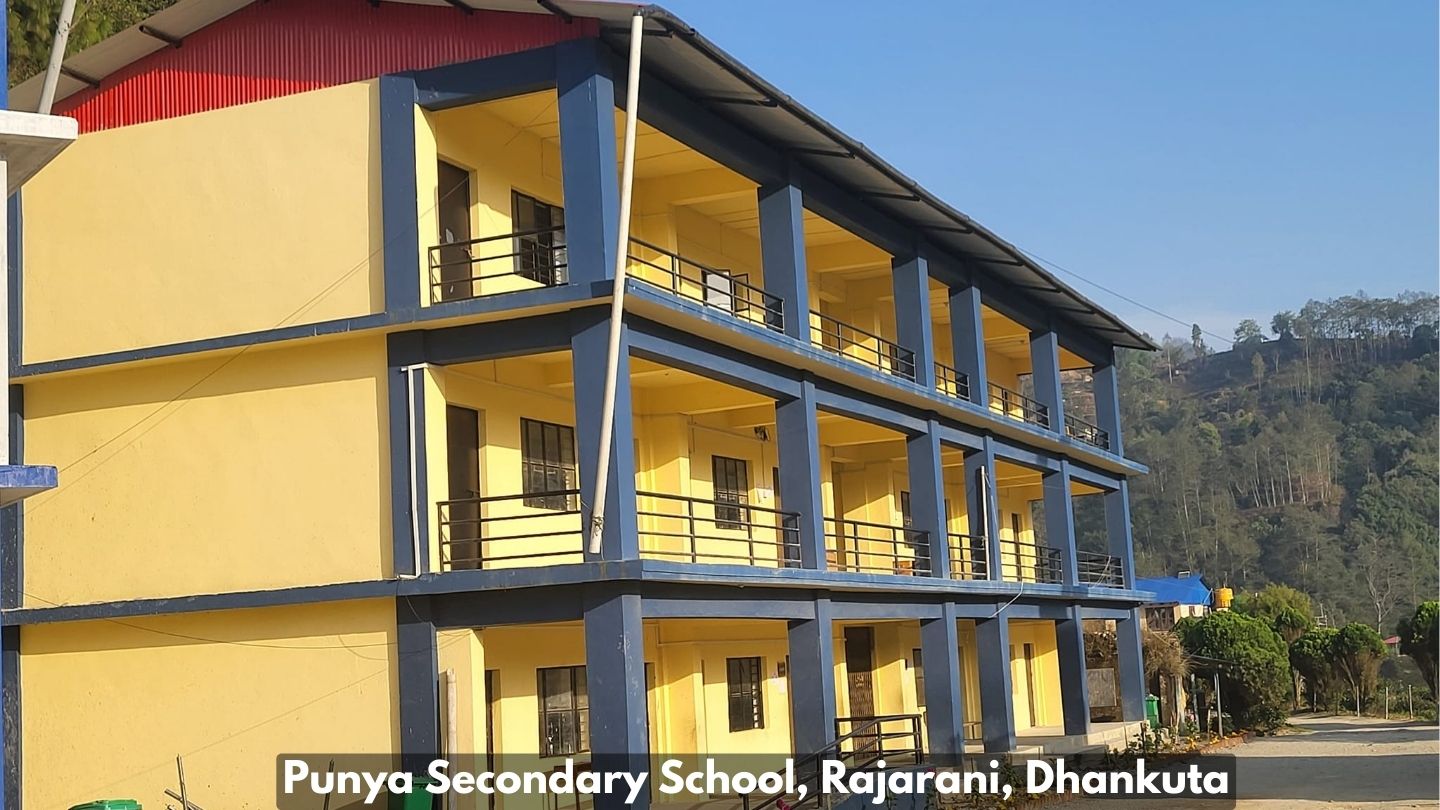
English Lab at Punya Secondary School, Rajarani, Dhankuta
At Punya Secondary School in Rajarani, Chaubise Rural Municipality–6, Dhankuta, there is a separate, well-decorated room. In this room, various artworks created by the students themselves are on display. Each of these artworks is discussed and explained in English.
When the project work prepared by students is arranged in an organized way, it not only looks good and attractive but is also used as a teaching-learning material. Students visit this room at different times. They learn or read whatever they need there. The room is usually crowded with students.
This room has been named the English Lab. Students say that this lab has greatly helped them in learning English and in presenting their own creative work. Nisan Yamphu Rai, a Grade 11 student at the school, says that this room has made the teaching and learning of English much easier. He says, “Here we have practical activities in English. This makes it easier to understand what we did not grasp in the classroom.”
For many community schools in rural areas, the teaching of English has become a headache. However, this school is becoming an example that English is not a problem if one knows how to teach it in a way that focuses on learning rather than just formal teaching.
The lab, which the school started operating three years ago, has not only supported the improvement of students’ English language skills but has also become a medium for the expression of their artistic talents. Materials prepared by teachers and students, which are used for teaching and learning the four skills and four aspects of the English language, have been collected here.
Practical exercises are carried out on the use of grammar, vocabulary, and all the activities included in the curriculum. Because of the combination of all these elements, it has become easier to understand the language, says Malati Limbu, a Grade 12 student. She says, “We have not only studied English; we have also understood it. This room has helped us more to understand than just to read.”
This practice was started after English teacher Badri Bajgain came to this school. Biographies of national luminaries, important personalities from within the country and abroad, and even individuals from the local municipality who have contributed to the nation have been prepared and kept here.
Similarly, various decorative items created by students have also been placed in the room. All these materials are explained in English. According to teacher Bajgain, the main objectives of all this are to make it easy to use teaching-learning materials, to make learning interesting and lively, to connect what is learned with art, and to conduct practical exercises for language development. He claims that this makes it much easier for students to learn the language.
Since the implementation of this programme, it has greatly helped improve the academic quality of students. In the year 2079, 90.69 percent of students passed English in the SEE, in 2080 the pass rate was 91.30 percent, and in last year’s SEE English subject, 94.7 percent of students passed.
Punya Secondary School Principal Yuvaraj Katuwal says that, after finding that this school’s way of teaching students is different from that of other schools in the municipality, student enrolment pressure at this school has started to rise. He says that teachers from other schools have begun paying observation visits to learn from the practice here for replication.

.jpg)

Comments 0
No comments yet. Be the first to start the conversation.