



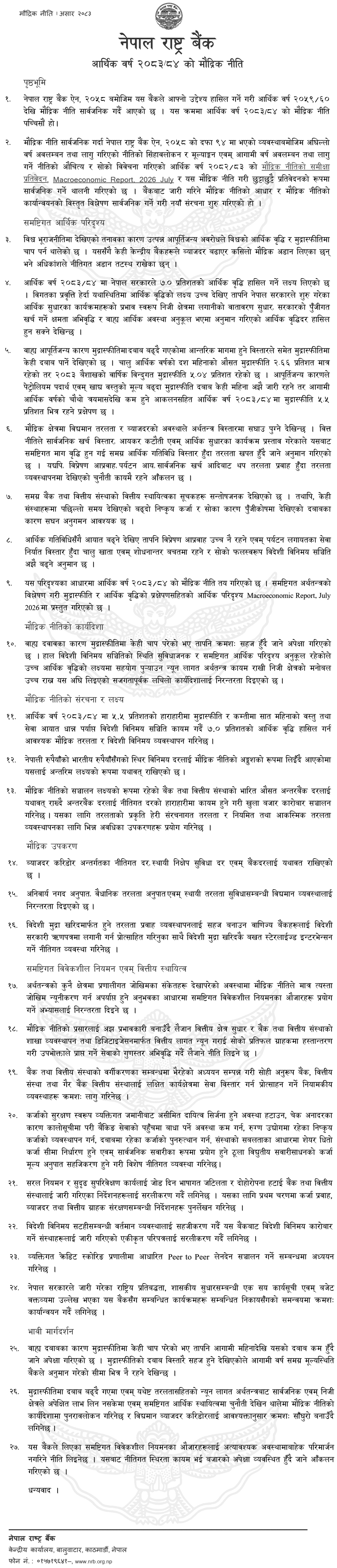
Nepal Rastra Bank has made public its twenty-fifth monetary policy for Fiscal Year 2083/84. The policy has projected support for the Government of Nepal’s target of achieving 7.0 percent economic growth and keeping inflation within 5.5 percent. It has continued the cautiously flexible policy stance while maintaining foreign exchange reserves sufficient to cover at least seven months of imports.
The policy rate, cash reserve ratio, and statutory liquidity ratio have been kept unchanged. Directives related to credit flow, interest rates, and financial customer protection will be rewritten, and the integrated circular will be simplified. In addition, policies have been included to improve personal credit scoring, digital transaction promotion, non-performing loans, and blacklist management. If external pressure and price increases rise, the policy stance will be revised to manage market expectations.
Table of Content
- Background
- Macroeconomic Outlook
- Monetary Policy Stance
- Monetary Policy Framework and Targets
- Macroprudential Regulation and Financial Stability
- Forward Guidance
Background
-
In accordance with the Nepal Rastra Bank Act, 2058, this Bank has been making public its monetary policy since Fiscal Year 2059/60 in a manner that supports the achievement of its objectives. In this process, the monetary policy for Fiscal Year 2083/84 is the twenty-fifth.
-
While making the monetary policy public, in accordance with the provision under Section 94 of the Nepal Rastra Bank Act, 2058, the Review Report of the Monetary Policy for Fiscal Year 2082/83, which includes the review and evaluation of the policy adopted and implemented in the previous year, as well as the justification and discussion of the policy to be adopted and implemented in the coming year, the Macroeconomic Report, 2026 July, and this monetary policy have been initiated for publication as separate reports. A new structure has been started to make public the basis of the monetary policy issued by the Bank and the detailed analysis of the implementation of the monetary policy.
Macroeconomic Outlook
-
Supply-side disruptions arising from tensions seen in global geopolitics have begun to put pressure on global economic growth and inflation. Along with this, some central banks have increased interest rates and taken a tight monetary stance, while most have kept their policy stance neutral.
-
In Fiscal Year 2083/84, the Government of Nepal has set a target of achieving 7.0 percent economic growth. Looking at past trends, the economic growth target appears high under the existing situation. However, as an effect of the economic reform programs initiated by the Government of Nepal, if the investment climate in the private sector improves, the government’s capacity for capital expenditure increases, and the external economic situation remains favorable, the projected economic growth rate appears achievable.
-
While pressure on inflation has been increasing due to external supply-side factors, expansion in domestic demand is also expected to put some pressure on inflation. The average inflation for the first ten months of the current fiscal year was only 2.66 percent, but the year-on-year inflation in Baisakh 2083 stood at 5.04 percent. With the assessment that inflationary pressure will continue for a few more months when the prices of petroleum products and food items rise due to supply-side factors, but will decline from the fourth quarter of the coming fiscal year, inflation is projected to remain within 5.5 percent in Fiscal Year 2083/84.
-
The existing liquidity and interest rate conditions in the monetary sector appear to support economic expansion. Since fiscal policy has proposed expansion of public expenditure, income tax reduction, and economic reform programs, aggregate demand is expected to increase, overall economic activities are expected to expand, and liquidity is estimated to be absorbed gradually. However, the challenge seen in liquidity management is expected to remain, as additional liquidity will flow through remittance inflows, tourism income, public expenditure, and other sources.
-
The financial stability indicators of the overall banks and financial institutions appear satisfactory. However, due to the increasing non-performing loans seen recently in some institutions and the pressure on capital funds caused by them, intensive monitoring is necessary.
-
Although imports are expected to increase along with economic activities, remittance inflows are expected to remain high, and exports of services, including tourism, are expected to expand. As a result, the current account and balance of payments are estimated to remain in surplus, and foreign exchange reserves are expected to increase further.
-
The monetary policy for Fiscal Year 2083/84 has been determined on the basis of this outlook. The economic outlook, including the analysis of the macroeconomy and the projections of inflation and economic growth, has been presented in the Macroeconomic Report, July 2026.
Monetary Policy Stance
-
Although inflation has come under some pressure due to external pressures, it is expected to ease gradually. Since the current foreign exchange reserve position is comfortable and the macroeconomic outlook is favorable, the cautiously flexible stance taken earlier has been continued to support the target of high economic growth, maintain a low-cost economy, and keep private-sector confidence high.
Monetary Policy Framework and Targets
-
In Fiscal Year 2083/84, monetary liquidity and foreign exchange management will be carried out as required to achieve 7.0 percent economic growth while maintaining inflation at around 5.5 percent and foreign exchange reserves sufficient to cover at least seven months of goods and services imports.
-
The fixed exchange rate of the Nepali rupee with the Indian rupee, which has been taken as the anchor of monetary policy, has been kept unchanged as the intermediate target.
-
The weighted average interbank rate of banks and financial institutions, which is the operating target of monetary policy, has been kept unchanged, and open market operations will be conducted so that the interbank rate remains around the policy rate. For this purpose, various instruments of different maturities will be used for structural liquidity management and regular and emergency liquidity management, depending on the nature of liquidity.
-
The policy rate, standing deposit facility rate, and Bank Rate under the interest rate corridor have been kept unchanged.
-
The existing arrangements related to the cash reserve ratio, statutory liquidity ratio, and standing liquidity facility have been continued.
-
To facilitate the management of liquidity flow through foreign currency purchases, commercial banks will be encouraged to invest in foreign government securities, and a policy arrangement will be made for sterilized intervention at the time of foreign currency purchase.
Macroprudential Regulation and Financial Stability
-
Based on the experience that monetary policy alone is insufficient to mitigate systemic risks when signs of such risks appear in any sector of the economy, the practice of using macroprudential regulatory tools will be continued.
-
A policy will be adopted to make monetary policy transmission more effective by reducing financial costs through financial sector reform and branch management and digitization of banks and financial institutions, transferring the benefits of such reduction to customers, and improving the quality of services received by consumers.
-
The ongoing study regarding the classification of banks and financial institutions will be completed, and regulatory arrangements will be gradually implemented accordingly to encourage banks, financial institutions, and non-bank financial institutions to expand services in targeted areas.
-
Special policy arrangements will be made to remove the situation in which unlimited liability is created through personal guarantees as loan security; to reduce the situation in which access to banking services is obstructed after being blacklisted due to cheque dishonor; to manage non-performing loans in sick industries; to revive stressed loans; to determine share-collateral loan limits based on the strength of the institution; and to facilitate the loan-to-value ratio for large electric vehicles used as public transport.
-
Emphasis will be placed on simple regulation and strong supervision by removing linguistic complexity and duplication and gradually simplifying the directives issued to banks and financial institutions. For this purpose, in the first phase, directives related to credit flow, interest rates, and financial customer protection will be rewritten.
-
The current arrangement related to foreign exchange will be facilitated, and the integrated circular issued by this Bank to institutions conducting foreign exchange transactions will be simplified gradually.
-
A study will be conducted regarding the operation of Peer to Peer transactions based on the personal credit scoring system.
-
The national commitments issued by the Government of Nepal, the one hundred-point agenda related to governance reform, and the programs related to this Bank mentioned in the budget statement will be implemented gradually in coordination with the concerned agencies.
Forward Guidance
-
Although inflation has come under some pressure due to external pressures, its pressure is expected to decline from the coming months. Since inflationary pressure appears to be easing gradually, the overall price situation in the coming year is expected to remain within the limit projected by the Bank.
-
If inflationary pressure continues to increase, if the public and private sectors are unable to obtain the expected benefits from a low-cost economy with adequate liquidity, and if challenges begin to appear in macroeconomic stability, the monetary policy stance will be reviewed, and the existing interest rate corridor will be gradually narrowed as necessary.
-
The Bank will adopt a policy of not revising the macroprudential regulatory tools it has adopted except in highly necessary circumstances. This is expected to maintain policy stability and gradually manage market expectations.
Nepal Rastra Bank
Central Office, Baluwatar, Kathmandu, Nepal
Phone No.: 01-5719641–, www.nrb.org.np
Asar 2083



Comments 0
No comments yet. Be the first to start the conversation.